Classic car leather upholstery: restore or retrim?
Classic car leather upholstery restoration: keeping the patina, repairing, recolouring or retrimming. Leather, foam, horsehair, springs, stitching and piping.
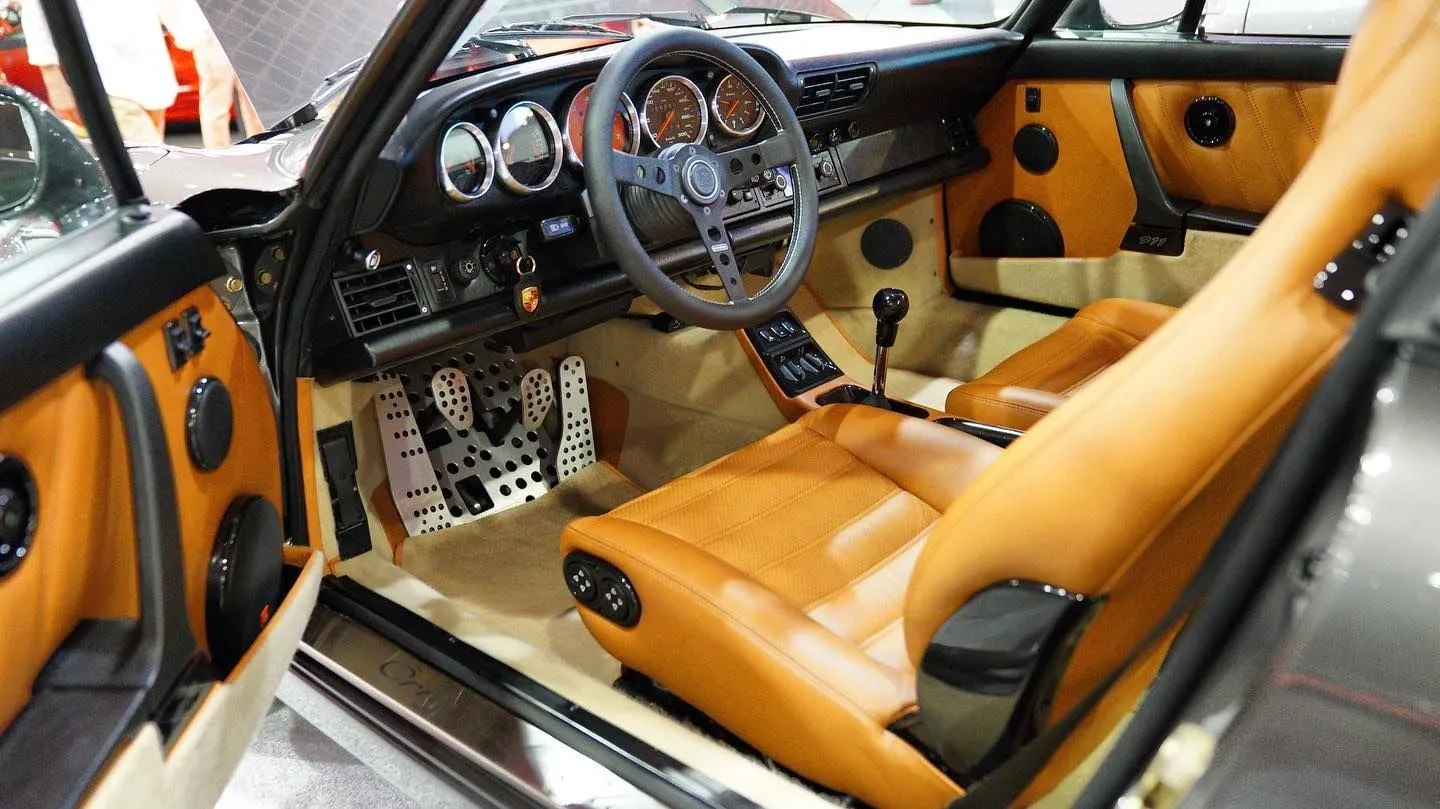
Original upholstery is a document. It carries the trace of every driver, every summer, every journey. On a collector’s car, it can be worth more than new leather, or, on the contrary, betray a neglected car. Before touching a seat, one simple and yet delicate question has to be answered: restore what is there, or retrim it all?
At our Mougins workshop, all upholstery is made on site. Here is how we approach that decision.
Patina or wear
Patinated leather and worn leather are not the same thing.
Patina is noble ageing: a colour that has deepened, a suppleness that has been earned, regular creases where the body rests. It is kept, and it is cared for.
Wear is deterioration: dry leather that splits, cracks running through the grain, seams giving way, a seat base collapsing. It can be repaired up to a point. Beyond that, the leather no longer holds.
Most older interiors combine the two. A passenger seat almost untouched, a tired driver’s seat: it is the most common situation, and it often calls for a nuanced answer.
What you cannot see
The leather is only the surface of a seat. Beneath it, a whole assembly ages too:
- springs and frame, which slacken, break or rust;
- hessian, the cloth stretched over the springs, which tears and lets the padding through;
- horsehair, on the oldest cars, which compacts and breaks up;
- foam, on more recent cars, which hardens, crumbles or sags.
Leather that still looks good on a collapsed seat base will never make a comfortable seat. In that case, it is sometimes possible to remove the cover, rebuild the padding beneath, then refit the original leather. It is slow work, but it preserves what matters.
On the 1967 Porsche 911 S Targa restored in our workshop, the original upholstery was worn down to the hessian and springs. It was redone, and the cabin regained its black trim. That project is also a reminder that not every original interior is leather: you need to know what the car wore before choosing a material.
Restoring original leather
When the leather is sound, several approaches are possible, from the lightest to the most thorough.
Cleaning and feeding
Gentle cleaning with suitable products removes ingrained dirt without attacking the finish. A nourishing treatment then restores suppleness to dry leather. This is often enough for well-kept upholstery, and it is the gesture to repeat regularly.
Repairing
A seam that has given way is restitched, with the same thread and the same stitch length as the original. A small tear is reinforced from behind. A badly damaged area, often the side bolster of the driver’s seat, can be replaced with a new panel, provided a leather can be found whose grain, thickness and colour match the rest.
Recolouring
Faded leather, or leather marked by rubbing, can be recoloured. The shade must be matched by eye, under several kinds of light, to stay true to the whole. Too heavy a recolouring stiffens the leather and takes away its feel: restraint is a virtue here.
Retrimming
Retrimming is not a failure. When the leather is brittle, torn in several places, or has already been replaced by a material unrelated to the original, new upholstery is the only honest answer.
Choosing the leather
Full-grain leather keeps its natural surface: it breathes, takes on a patina and ages well. Corrected-grain leather has been buffed and then given a surface coating; it is more uniform, but it does not patinate in the same way. Tanning, thickness and suppleness are chosen for the use: a seat base, a backrest, a door card or a dashboard do not work in the same way.
Patterns and details
Successful upholstery respects the original proportions: the width of the pleats, the position of the seams, the presence or absence of perforations, the piping that underlines an edge. Patterns are taken from the old covers when they still exist. The thread, its colour and the stitch length count as much as the leather itself.
From seats to boot
Upholstery does not stop at the seats. Door cards, dashboard, console, headlining, carpets and boot lining form a whole. Redoing them separately risks differences in colour and grain.
Three projects from our workshop
A few examples from Our Work:
- Porsche 964 Carrera 4: stitched seats, door cards and trim in cognac leather, sewn in-house, with a front luggage compartment lined in quilted leather.
- Mercedes-Benz 280 SL Pagoda: seats, door cards, dashboard and boot redone in cognac leather with sewn pleats, beneath black lacquer.
- Ferrari 612 Scaglietti: covers stitched stitch by stitch, then stretched by hand over the seat bases; the dashboard trimmed in leather; blue-green leather, light piping and an embroidered prancing horse on the headrest.
Three cars, three points of view. In each case, the leather and the design were chosen to suit the car, not the other way round.
How to decide
A few questions help to settle it:
- Is the upholstery original? If so, keeping it has a value of its own, particularly on a car intended for concours or a collection.
- Is the leather sound? Supple and whole, it can be restored. Dry and brittle, it will not last.
- Is the padding beneath tired? It can be rebuilt without changing the leather.
- How will the car be used? A car that is driven often needs upholstery that can take it.
- What coherence for the whole? A new seat beside a patinated one can jar; sometimes it is better to harmonise.
There is no universal answer. There is, however, a right answer for each car, and it is found by looking closely at the upholstery, by hand, dismantling where necessary.
How we work
You can send us photographs of the cabin: seats, door cards, dashboard, close-ups of the stitching. We give you a first opinion, then a detailed quotation, confirmed once the car has been examined at the workshop. Upholstery is quoted individually, according to the area, the leather and the level of detail. While the work is under way, you follow each stage in photographs.
Our upholstery page shows the workshop’s craft in pictures. For a car that needs more, a full restoration brings upholstery, mechanics and bodywork together in a single project.
In closing
Keeping original leather calls for judgement; retrimming it calls for rigour. In both cases, the result should look inevitable, as though it had always been there. If you are unsure about your own car, you are welcome to write to us or request a quotation from a few photographs.
The Original Classic & Luxury Cars team