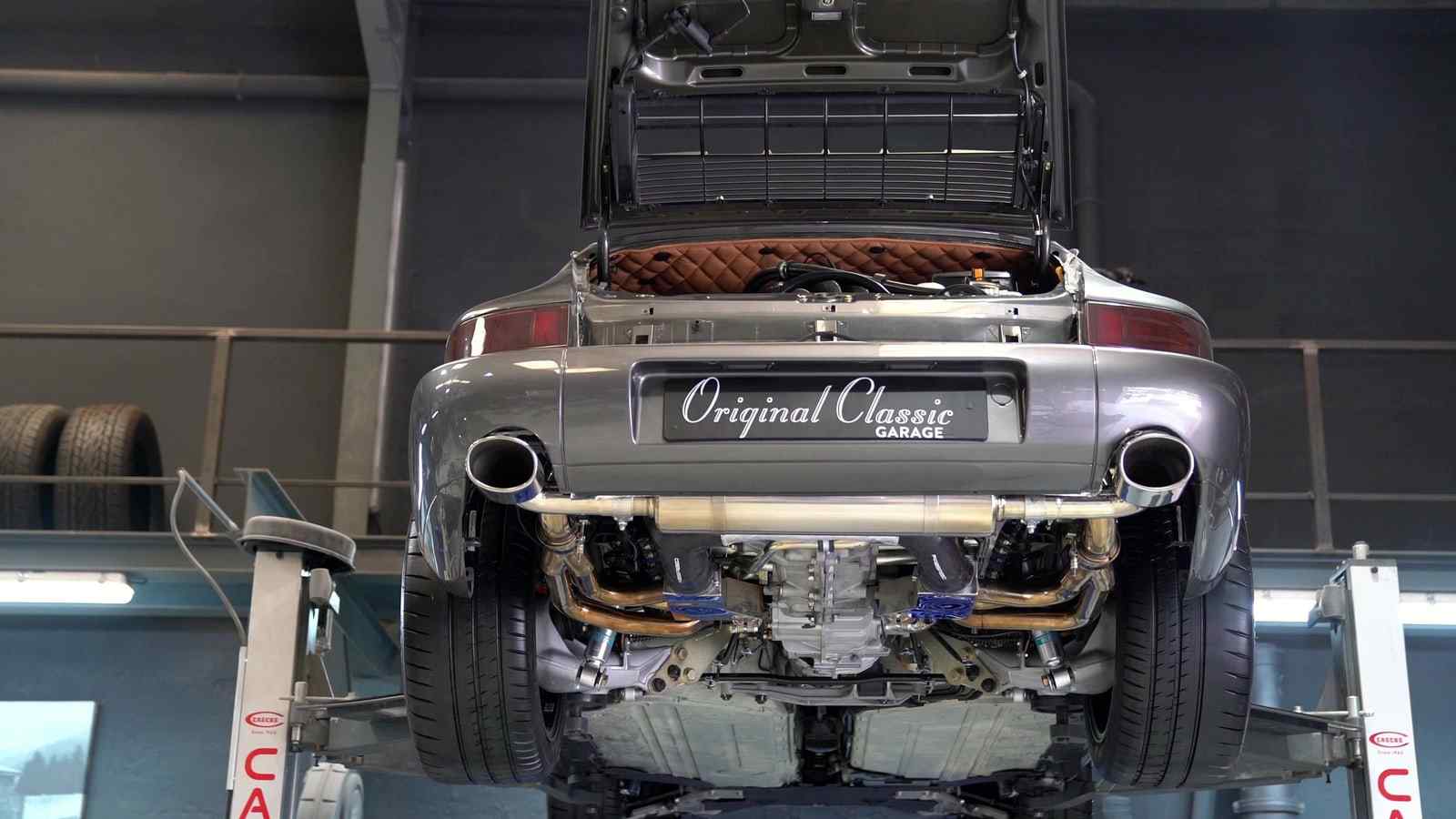
What does an annual service include on a classic or prestige car?
Classic car servicing follows the manufacturer’s schedule, but does not stop there. The service begins with an inspection: leaks, the condition of boots and hoses, play in the steering, noises on the road. The scheduled operations are then carried out, and anything the inspection reveals is reported to you before any further work.
- Engine oil and filter change, using oil of the prescribed specification.
- Air, cabin and fuel filters according to the schedule; spark plugs where they are due.
- Brakes: pads, discs, hoses and the condition of the fluid.
- Fluid levels and condition: coolant, gearbox, power steering, screenwash.
- Auxiliary belts, battery, lights, tyres and safety points.
Brake fluid and coolant: why change them even when the car is not driven?
Brake fluid absorbs moisture from the air. Over time its boiling point falls, and the water it holds attacks the system from within: calipers, master cylinder, pipes. It is therefore changed according to the manufacturer’s schedule, whether the car has been driven or not. Work on the braking system is set out on the brakes page.
Coolant, for its part, gradually loses its anti-corrosion properties. Yet it is what protects the engine’s internal passages, the water pump and the radiator, especially where the block or cylinder head is aluminium.
Cambelt and water pump
A timing belt gives no warning: when it snaps, on many engines, valves and pistons meet. It is replaced according to the manufacturer’s schedule, which takes age into account as much as mileage. Where the water pump is driven by the same belt, it is replaced at the same time, together with the idlers and the tensioner.
This is common at Ferrari, where many V8 and twelve-cylinder engines use belts: see the Ferrari cambelt service and Ferrari servicing. Air-cooled Porsche flat-sixes use chains, with their own checks, described under Porsche servicing.
Air conditioning, wheel alignment, tyres
Air conditioning that no longer cools properly is usually short of refrigerant, which points to a leak. Before any regas, the system is checked for leaks: regassing without finding the leak only postpones the problem.
Wheel alignment (toe, camber, castor) is checked after suspension parts are replaced, after hitting a kerb, or when tyres wear unevenly. As for the tyres themselves, their age matters as much as their tread: over time the rubber hardens and grips less, even when the tread looks intact.
A car that is rarely driven, and its service history
A car that sits for long periods wears in other ways: a battery that drains, seals that dry out, discs that corrode, fuel that goes stale in the tank, tyres that flat-spot. A battery conditioner, regular recommissioning or storage with seasonal preparation avoid most of these problems. Recent models, full of control units, draw current even when parked: their battery is the first thing to watch.
Every job appears on a detailed invoice, operation by operation, with part and fluid references: this is the service history that will stay with the car. The particulars of each marque are covered under Lamborghini servicing, McLaren servicing, Bentley servicing and Rolls-Royce servicing. For a warning light or a specific symptom, start with a diagnostic check.