Clutch slipping, juddering or noisy: what is the cause?
Every clutch replacement starts with a drive and careful listening. The symptoms resemble one another, but their causes differ, and the same sensation can come from the release system, the friction plate, the flywheel or the gearbox. We separate them before proposing anything, first with the car stationary, then on the road.
- Slipping: revs rise without the car accelerating, especially in a high gear; worn plate or linings contaminated by oil
- Judder when pulling away: plate, flywheel, cover, or tired engine and gearbox mounts
- High biting point: a common sign of a plate near the end of its life on a self-adjusting system
- Noise with the pedal pressed: release bearing; noise with the pedal released that stops when you declutch: more likely a gearbox bearing
- Heavy pedal, a pedal that stays down or difficult gear changes: hydraulics, cable or adjustment
Cover, plate, release bearing and flywheel
A clutch consists of a diaphragm cover, a friction plate and a release bearing; these parts wear together and are, as a rule, replaced together. The flywheel is inspected every time the clutch is opened up: flatness, heat marks, starter ring gear. Depending on its design and the manufacturer’s guidance, it is refaced or replaced.
Many sports cars since the late 1980s use a dual-mass flywheel, which filters engine vibration; the Porsche 964 is one of them. A tired dual-mass flywheel knocks at idle or when the engine is switched off, and shows excessive play. Replacing it with a single-mass flywheel is sometimes suggested; we explain the consequences for vibration, gearbox noise and originality before any decision.
With the car opened up, we also check the crankshaft rear oil seal, whose leak contaminates the plate, as well as the release fork, the bearing guide and the mounts. If the gearbox itself has a fault, this is the right moment to discuss it.
Hydraulic or cable release
On a hydraulic system, the clutch master cylinder at the pedal box drives the slave cylinder on the gearbox. Their seals age, leak or let air in; the fluid, often shared with the braking system, absorbs moisture just like that of the brakes. We rebuild or replace master and slave cylinders, renew the hose and bleed the system.
On older cars with a cable release, the cable, its outer sleeve, its guides and the pedal box govern how smooth the pedal feels. A fraying cable or poor adjustment gives a heavy pedal and a clutch that no longer frees completely.
Automated manuals: Ferrari F1, Lamborghini e-gear, BMW SMG
The automated manual gearboxes of the 1990s to 2010s, such as the F1 gearbox of the Ferrari 360 and F430, the e-gear of the Lamborghini Gallardo and Murciélago or the SMG of the BMW M3 E46 and M5 E60, use a conventional dry clutch operated by an electronically controlled hydraulic system. Their wear depends heavily on use: manoeuvring, dense traffic and hill starts make it progress faster.
Wear on these clutches is estimated with a suitable diagnostic tool, which reads the values calculated by the control unit. After replacement, the contact point has to be relearned and the system calibrated. The pump, accumulator and sensors of the actuation system are checked at the same time. The specifics of the Ferrari F1 clutch and the Lamborghini e-gear clutch are covered on their own pages.
PDK and DCT dual-clutch gearboxes: what the workshop does
Recent dual-clutch gearboxes, PDK at Porsche and DCT at Ferrari, Lamborghini or McLaren, work with two wet clutches running in oil, controlled by a mechatronic unit. The workshop reads fault codes, checks the adaptations, changes the fluid according to the manufacturer’s programme and diagnoses jerky shifts or slipping.
Depending on the fault and the parts available from the manufacturer, the work can range from an adaptation to the replacement of a complete assembly. We do not promise an internal mechatronic repair: we tell you clearly what is possible for your car. Porsche, from cable clutch to PDK, is covered on the Porsche clutch page.
How does a clutch replacement proceed?
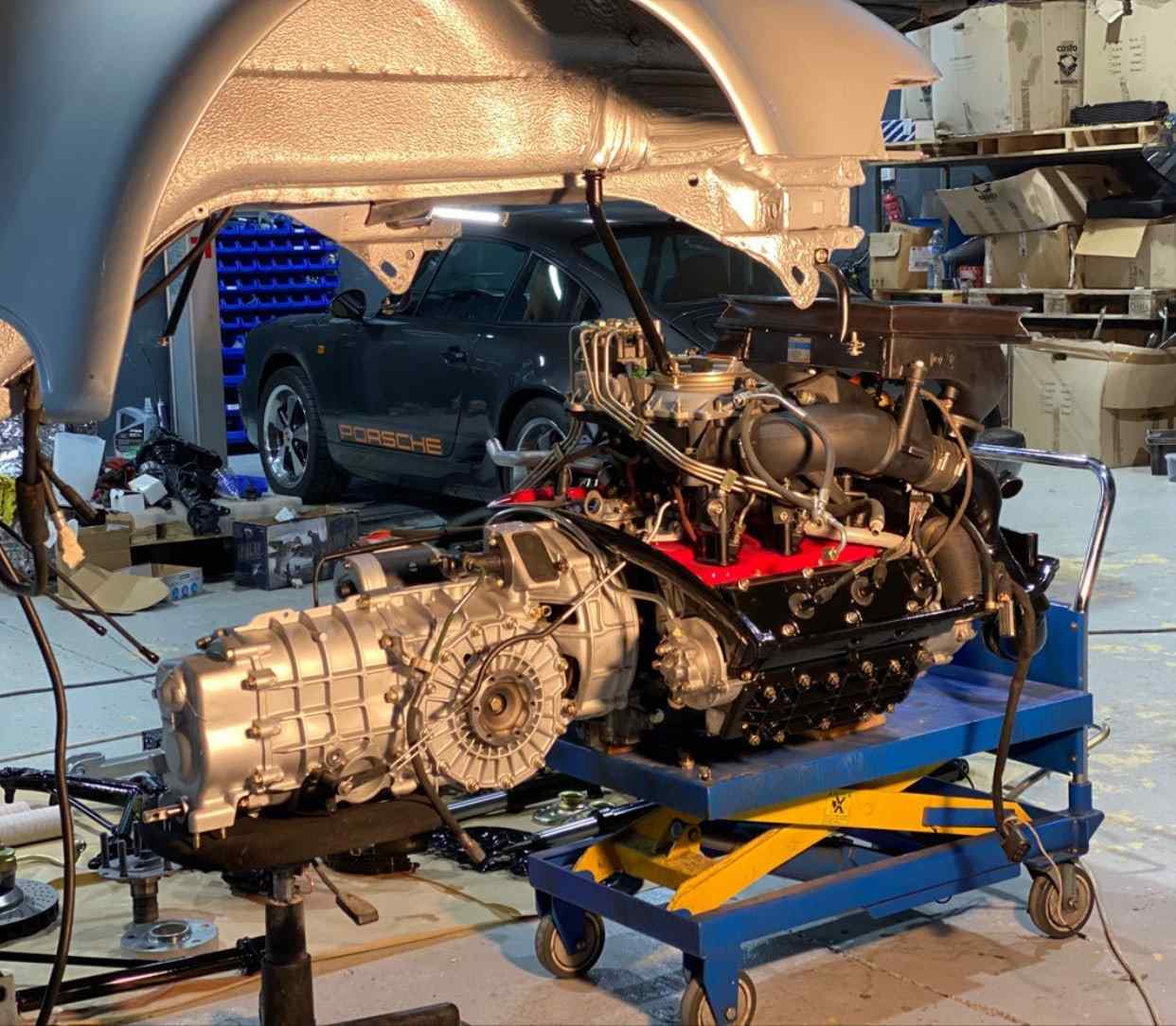
Depending on the layout, access means removing the gearbox or the complete engine and gearbox: on an air-cooled Porsche 911, for example, the powertrain is lowered out of the car. The car is inspected before the quotation, itemised line by line; the removed parts are photographed and you receive photographs of the key stages. No additional work is carried out without your agreement.
The car is road-tested after reassembly, and the detailed invoice is added to its history. You can request a clutch quotation, including remotely from photographs and videos, ahead of the inspection.