What are the signs of a worn Porsche clutch?
A clutch wears with use far more than with age: hill starts, town traffic and hard launches load it more than long journeys.
Not every symptom points to the friction plate: a badly adjusted release mechanism, a stretched cable or a leaking slave cylinder can mimic them perfectly. A road test and a proper diagnosis before any estimate avoid replacing a clutch that is still good.
- slipping: revs rise without the road speed following, above all in a high gear under load
- a biting point very high in the pedal travel
- judder when pulling away
- gears hard to select at standstill, a sign the clutch is not fully releasing
- a noise that appears or disappears as the pedal is pressed
- rattling at idle or when the engine stops, typical of a tired dual-mass flywheel
- a heavy or spongy pedal, or one that returns slowly
Porsche 911 clutch on classic cars: cable, G50 and Sportomatic
From the first 911s to the 1986 3.2 Carrera with its 915 gearbox, and so on the 911 SC, the clutch is cable-operated from a floor-hinged pedal box. Cable adjustment, the condition of its outer sleeve and of the pedal box bushes matter as much as the clutch itself: a heavy pedal or a wandering biting point often comes from there. With the G50 gearbox, fitted to the 3.2 Carrera from the 1987 model year, the clutch becomes hydraulic, with master and slave cylinders working on brake fluid.
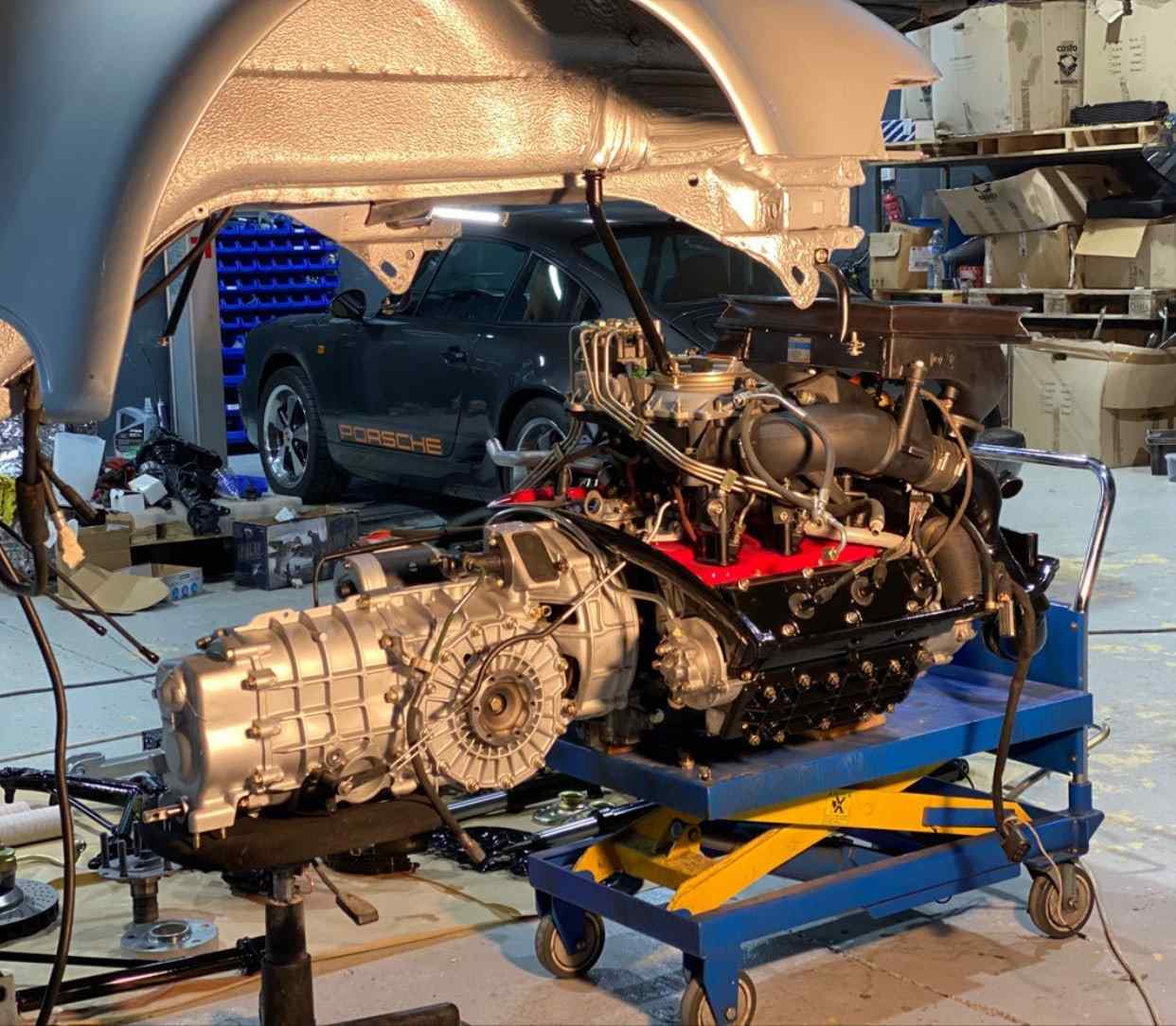
The 930 Turbo kept its four-speed gearbox until 1988; the final year received the five-speed G50, like the 1989 930 Turbo Cabriolet whose engine and gearbox were overhauled during its restoration at the workshop. Sportomatic 911s, offered from the late 1960s to 1980, have no clutch pedal: a vacuum-operated dry clutch, engaged as soon as the lever is touched, works alongside a torque converter, and its control needs its own adjustment.
Dual-mass flywheel: 964, 993 and later
The 964 introduced the dual-mass flywheel to the 911; it is also found on the 993, the 968 and the water-cooled generations. Its two masses, linked by springs, smooth the flat-six’s pulses, but they wear: excessive free play, rattling at idle, vibration when pulling away. The flywheel is measured at every clutch replacement and renewed if it is out of tolerance.
Some 964 and 993 owners consider a single-mass flywheel. It makes the engine pick up revs more eagerly but increases gearbox rattle at idle: we discuss it with you rather than impose it.
Porsche 996, 997, Boxster 986 and Cayman 987 clutch: IMS and rear main seal
On the M96 and M97 engines of the 996, the first-generation 997, the Boxster 986 and 987 and the Cayman 987, a clutch replacement exposes the back of the engine. It is the moment to examine two well-known points: the rear main seal, whose weeping then shows on the bellhousing and flywheel, and the intermediate shaft bearing, known as the IMS. Depending on engine and year, that bearing can be replaced from the rear or cannot be without opening the engine: we identify it, inspect it and set out the options, committing to nothing without your approval. The 9A1 engines of the second-generation 997 and 987 no longer have an intermediate shaft.
The kit usually comprises friction plate, pressure plate and release bearing. The dual-mass flywheel, slave cylinder, release fork and pedal helper spring are judged on inspection. For anything concerning the engine itself, see our Porsche engine rebuild page.
PDK gearbox and Cayenne: what can be done
The PDK gearbox, introduced on the 911 for the 2009 model year and then across the range, uses two wet multi-plate clutches running in oil. There is no clutch to replace in the usual sense: the workshop reads fault codes and the adaptation values stored by the control unit, runs the adaptations again after any work, and changes the oil according to the manufacturer’s schedule. We do not promise internal gearbox repair; if the diagnosis calls for it, we explain the possible solutions, described on our Porsche gearbox page.
Most Cayennes use a torque-converter automatic with no clutch pedal. The early generations were also offered with a manual gearbox, mainly with the V6, with a conventional clutch and dual-mass flywheel; the hybrid versions use a separating clutch between the petrol engine and the electric motor, controlled by an actuator.
Porsche 924, 944 and 968 clutch: the transaxle case
On the 924, 944 and 968, the engine sits at the front and the gearbox is mounted to the rear axle, joined by a rigid torque tube that houses the driveshaft. The clutch remains on the engine: replacing it means removing the gearbox and sliding the tube back. The job is heavier than it looks, and it is the moment to check the shaft bearings, the mountings and, on the 944 and 968, the hydraulic release system.
How does a clutch replacement work at the workshop?
The car is road-tested, then examined on a lift before any estimate. The estimate separates the clutch replacement itself from the parts to be judged once dismantled; you receive photographs of what we find, and nothing is added without your approval. Parts are genuine, equivalent quality or reconditioned according to availability and your choice, with their origin stated on the invoice, which then serves as a service record. Our clutch replacement page explains the method we apply to every marque, and our Porsche specialist page gathers all our work on the marque.