When should a Porsche 911 be serviced?
Porsche servicing follows the manufacturer’s schedule, which combines mileage and time: whichever comes first applies. A car that covers few miles still ages. Oil turns acidic, brake fluid absorbs moisture, tyres and hoses harden, even in a garage.
Before each service, the car is examined and the estimate itemised line by line. Anything the inspection finds beyond the schedule is shown to you, with photographs; no additional work is carried out without your approval.
How is an air-cooled Porsche serviced?
From the 1964 911 to the 993, the flat-six is air-cooled and dry-sump lubricated: the oil comes from a separate tank and helps to cool the engine. Its level is read hot, at idle, with the car level; its condition matters as much as its quantity. The four-cylinder engine of the Porsche 356 asks for the same care, carburettors and ignition included.
At every visit the workshop checks:
- the oil and filter change, the oil cooler and its lines;
- oil tightness: rocker covers, oil return tubes, crankcase;
- valve clearances on engines with manual adjustment, the 993 being the first to adopt hydraulic lifters;
- ignition: points and advance on early 911s, twin-plug ignition on the 964 and 993, spark plugs to the schedule;
- the belt that drives the alternator and cooling fan, its tension and condition.
IMS bearing, rear main seal: what to watch on a 996, 997 or Boxster?
The M96 and M97 engines, fitted to the 996, early 997 Carreras and first-generation Boxsters and Caymans, have well-known weak points. The intermediate shaft (IMS) bearing can fail: its condition is monitored, and a preventive replacement with an uprated part is considered according to the engine and its history. The rear main crankshaft seal is prone to leaks. On some versions, bore scoring can appear; an endoscope inspection is the way to look for it.
The 996 and 997 Turbo, GT2 and GT3 use a different, race-derived engine without this weakness. From 2009, the 9A1 direct-injection engine does away with the intermediate shaft. On every water-cooled car the cooling system deserves attention: the front radiators trap leaves and debris, and coolant is renewed to the schedule. Reading the control units completes the inspection, as our Porsche diagnostics page explains.
Manual, Tiptronic or PDK: how is the gearbox maintained?
Tiptronic arrived with the 964; the PDK twin-clutch gearbox came to the 911 in 2009, with the second-phase 997. Their oil is changed to the manufacturer’s schedule, with the specified fluid. On a 915 or G50 manual gearbox, we check the oil, leaks, the shift quality and the behaviour of the clutch.
Front-engined Porsches, the 924, 944, 968 and 928, have a cambelt to be renewed to the schedule. The 911 uses timing chains instead, so the tensioners and any timing noise are watched.
Servicing a Porsche Cayenne or Macan: what is different
A Cayenne or a Macan is heavy and powerful: brakes, brake fluid, tyres and suspension work harder than on a 911. All-wheel drive adds its own components, transfer box, propshafts and differentials. On early Cayenne generations, the transfer box and the propshaft centre bearing are known issues, checked at every visit.
Discs, pads and calipers are covered on our Porsche brakes page. Hybrid and electric versions are examined before any estimate; work on the high-voltage system is assessed case by case.
Does independent servicing protect the Porsche warranty?
European law allows a car still under warranty to be serviced outside the manufacturer’s network, provided its schedule is followed and parts of equivalent quality are used. The itemised invoice, stating the origin of every part, then joins the car’s service history.
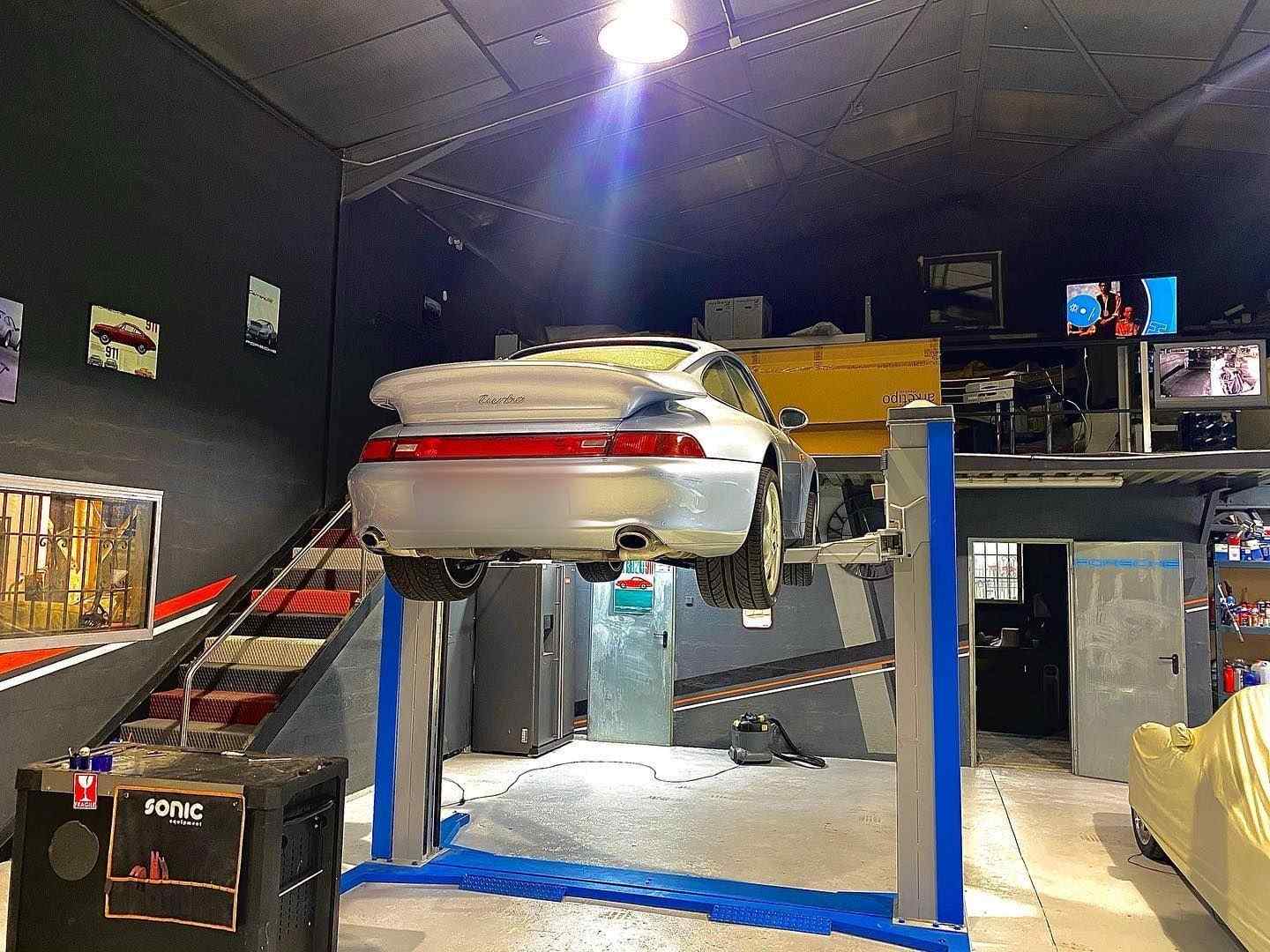
Recently, the workshop carried out the oil change and fluid renewal on a Porsche 993 Turbo, the last air-cooled Turbo. To choose a date, you can book an appointment online.