Pre-A, A, B and C: the 356 generations
The Porsche 356 was built from 1948 to 1965. The first cars were made in Gmünd, Austria, before production moved to Stuttgart from 1950. For a restoration, the generation matters as much as the body style: each series has its own panels, trim, engines and details, and a faithful classic Porsche restoration always begins by identifying the car precisely.
- Pre-A (up to 1955): the earliest 356s, first with a split windscreen, then a one-piece bent screen.
- 356 A (1955–1959): curved windscreen, revised running gear and engines, and the arrival of the 1600.
- 356 B (1959–1963): raised headlamps and bumpers; T5 body, then T6 with a wider front lid and a fuel filler flap in the right front wing.
- 356 C (1963–1965): disc brakes on all four wheels and the final versions of the four-cylinder engine.
- Bodies mostly by Reutter, with Karmann, Drauz or D’Ieteren building certain versions, which explains small differences from one car to the next.
Coupé, Cabriolet, Speedster or Roadster: what is the difference?
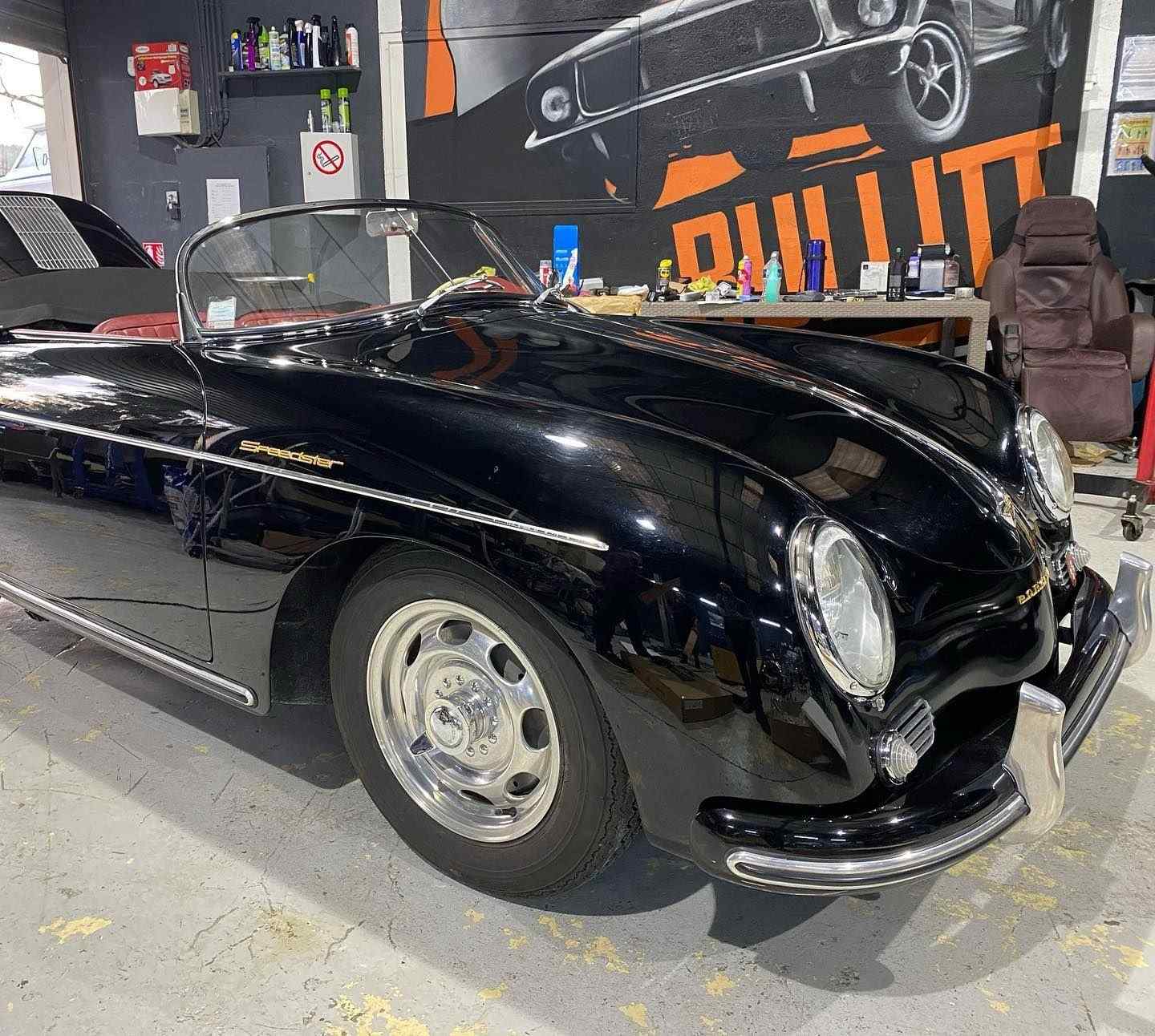
Coupé and Cabriolet are the most common body styles. The Speedster, introduced in 1954 and built until 1958, is the most stripped-back: a low windscreen, a lightweight hood, side curtains instead of wind-up windows and simple bucket seats. It was followed by the Convertible D and then the Roadster on the 356 B, both more civilised while remaining open cars.
These differences matter in the workshop: a Speedster windscreen, hood frame or trim panel cannot be replaced with a Cabriolet part. With so many replicas on the market, checking authenticity (chassis, engine and body numbers, plates and paperwork) is part of the initial inspection.
Porsche 356 rust: where to look
The 356 has a steel monocoque with no corrosion protection in the modern sense. Sixty years and more after leaving the factory, rust often hides beneath flattering paint or earlier repairs. The areas to inspect first:
- floor pans and the central tunnel;
- sills and longitudinals, including the jacking points;
- the nose and the battery box in the front luggage compartment;
- wheel arches, the lower wings and door bottoms;
- panel joints, which the factory smoothed with lead;
- door and lid gaps, which reveal a tired or poorly repaired shell.
How is a Porsche 356 restored?
A full restoration starts with a complete strip-down and an inventory of every part, photographed and labelled. The shell is then taken back to bare metal: the only way to see how far the corrosion really goes. The metalwork replaces rotten sections with hand-formed panels or repair sections, following the original shapes and weld points; this is the heart of Porsche bodywork.
Primer, panel fitting and paint follow, in an original colour or one chosen by the owner. The approach is the same as for the media-blasted, epoxy-primed 964 shell seen in our workshop photographs, adapted to the thin steel and lead-loaded seams of the 356. Throughout the work, photographs of each important stage are sent to you, and no additional work goes ahead without your approval.
Engine, gearbox and brakes
The 356 uses an air-cooled flat four, mounted behind the rear axle, with pushrod-operated valves. Capacity grew from 1.1 to 1.6 litres over the years, with more potent versions such as the Super 90 and the SC. A rebuild means stripping the engine completely, measuring every tolerance, replacing or reconditioning what is needed (pistons and barrels, bearings, valves, guides), then setting up the ignition and carburettors before a road test.
The four-cam Carrera engine, with its overhead camshafts driven by shafts and bevel gears, is a case apart: offered in 1.5, 1.6 and then 2.0-litre form, it is notoriously complex to time and rebuild. It is only tackled after a thorough assessment and with carefully identified parts; our approach is set out on the Porsche engine rebuild page.
The four-speed gearbox uses Porsche’s own split-ring synchromesh, introduced in the early 1950s; rings, forks and bearings are all checked during a rebuild. Brakes are drums up to the 356 B and discs on the 356 C. At the front, the trailing arms and transverse torsion bars are inspected together with the steering.
Interior trim and hood
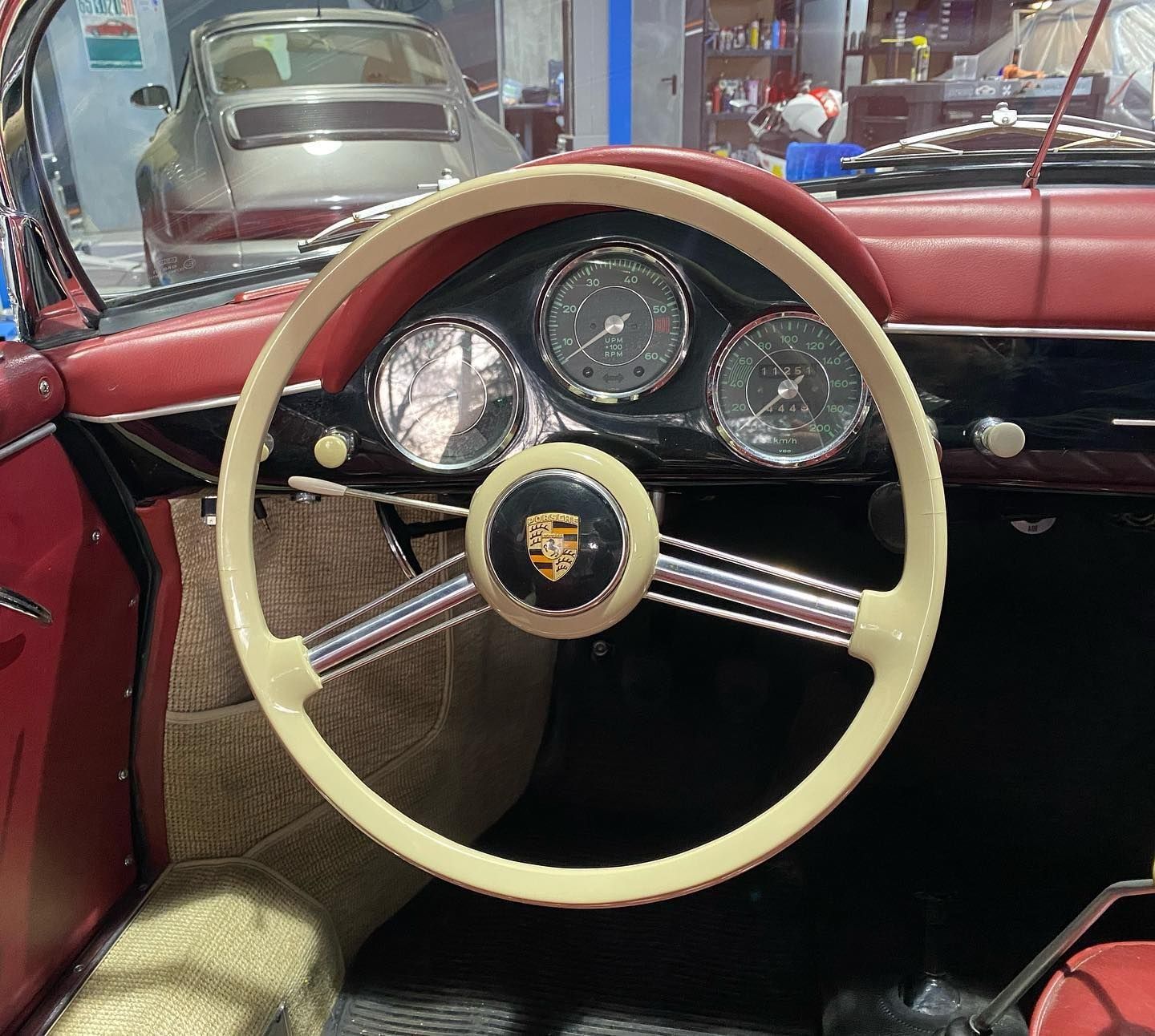
A 356 interior is simple but tightly defined: seats, door cards, carpets, headlining, a painted or trimmed dashboard depending on the version, and a hood on open cars. All upholstery is made in our own workshop: patterns taken from the existing parts, materials chosen to match the original (leather or leatherette), stitching and piping true to the series. More on the craft on our Porsche upholstery page.
On a Speedster, the hood and side curtains need careful fitting to the frame and windscreen; otherwise both weathertightness and the line of the car suffer.
What our workshop does for your 356
A black 356 Speedster photographed in our Mougins workshop is a reminder of what these cars ask for: time, correct parts and one team from start to finish. For a 356 we offer full or staged restoration, servicing and mechanical work, bodywork, paint and upholstery, with a detailed, line-by-line quotation after the car has been inspected.
You decide between strict originality and a personal interpretation, such as a different colour or interior. Parts are original, equivalent quality or reconditioned, depending on availability and your preference, with their origin stated. Transport can be arranged from anywhere in Europe. The 356’s direct successor, the Porsche 911 of 1964 to 1973, has its own page, as does our work on the Porsche marque as a whole.