What does Porsche 911 upholstery cover?
Porsche upholstery is about far more than seats. On a 911, it covers cushions and backrests, door cards, the dashboard, the headlining, the cabin carpets, the front luggage compartment trim and, depending on the body, the hood of a Cabriolet or the trim of a Targa. Each part is removed, assessed and then remade in the workshop, where all upholstery is carried out in-house.
The work begins with a survey: materials in place, stitching, piping, colour, condition of foams and frames. On an older car, this survey often shows what is original and what has been redone by successive owners. It guides the choice of materials and the estimate, itemised line by line.
- seats: cushions, backrests, headrests, foams and frames
- door cards, rear side panels and armrests
- dashboard and instrument binnacle
- headlining, sun visors and pillar trims
- cabin carpets and front luggage compartment trim
- Cabriolet hood and Targa trim
Pepita, tartan, Pasha: finding the right period cloth
Many 911s of the 1960s and 1970s are recognised by their cloth: Pepita, the houndstooth now inseparable from the marque, and the tartans Porsche offered as seat inserts. The 1980s added the black-and-white chequered pattern known as « Pasha ». A Pepita insert at the wrong scale, or a tartan that does not line up across the seat, is noticed at once.
When a car is to stay true to its original specification, the workshop sources the cloth closest to the original in design, pattern scale and texture, then respects the cut of each insert and the direction of the pattern on every panel. On a car treated in a more personal spirit, the same fabrics can be paired with leather, as part of a bespoke Porsche build.
Leather, leatherette and sports, comfort or bucket seats
Depending on the year and options, a classic Porsche could be trimmed in leatherette, cloth, leather or a combination of the three. On early 911s, leatherette was common and leather was often an option, so it is worth knowing what the car wore when it left the factory before choosing.
The seats themselves vary just as much: comfort seats, sports seats with firm lateral support, shell-type bucket seats. Restoring them goes well beyond a new cover. Foams sag, webbing and springs tire, frames corrode, adjusters develop play. The workshop rebuilds the structure before the cover is stretched over it; otherwise even the finest hide will eventually lose its shape.
On the 1967 911 S Targa restored in our workshop, the original upholstery was worn down to the jute and the springs. The seats were rebuilt from their structure up, and the cabin was given black upholstery in keeping with the car.
A cognac leather interior: the 964 Carrera 4
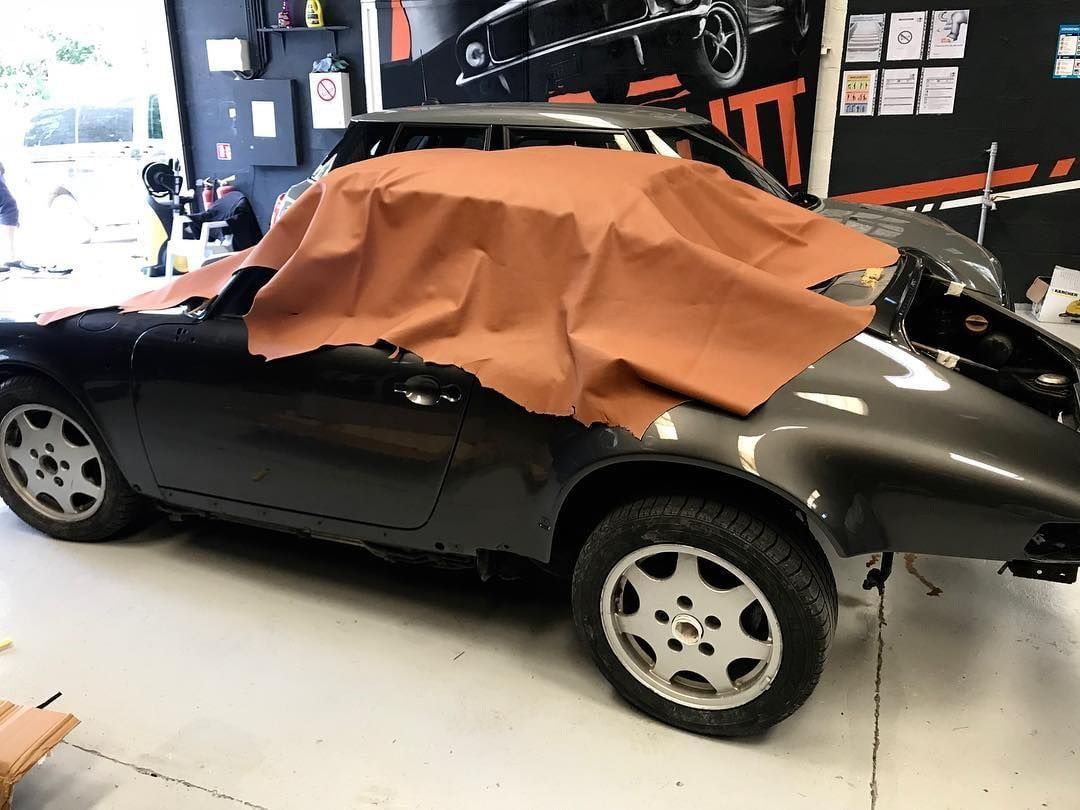
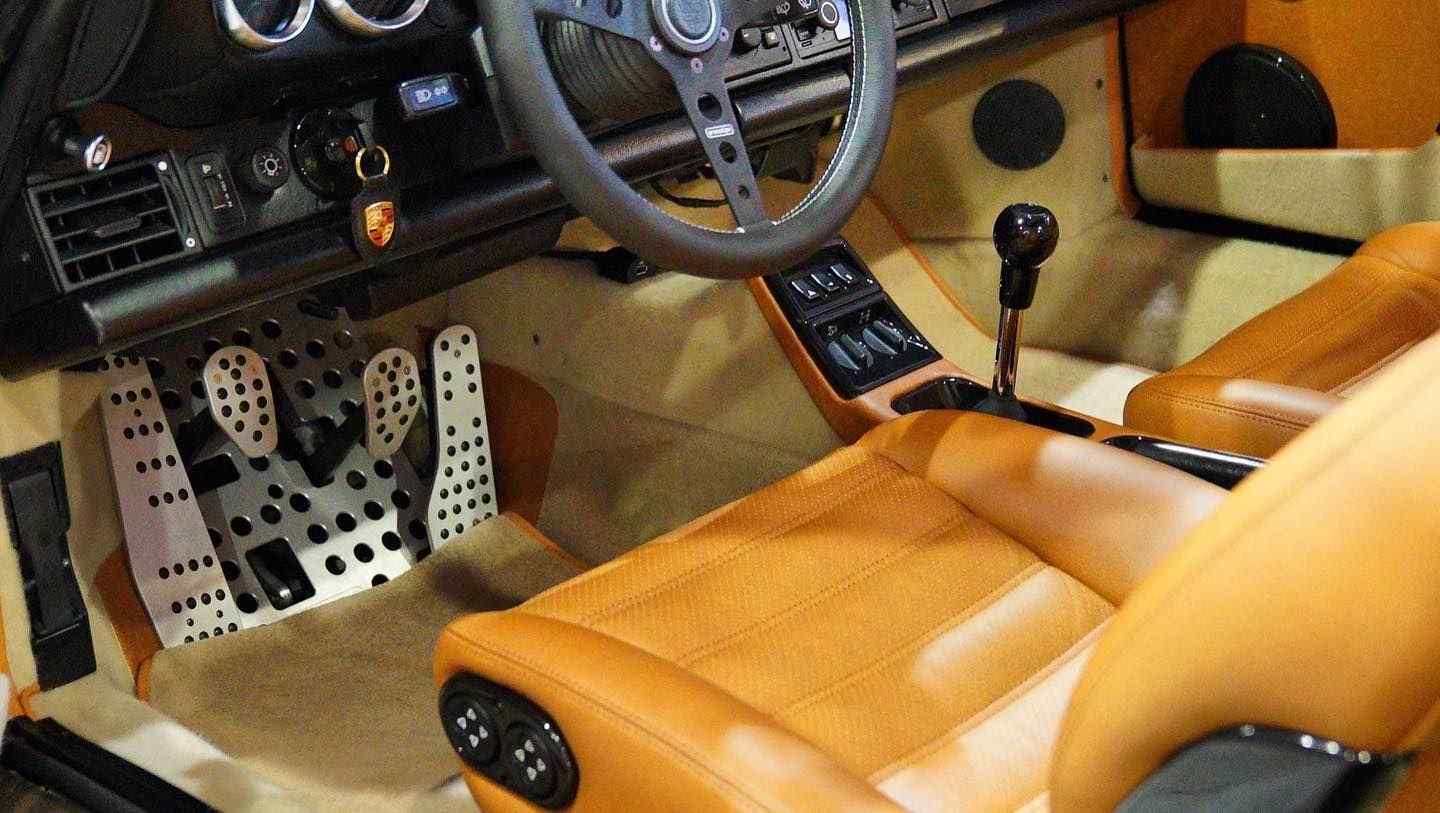
The 964 Carrera 4 restored in our workshop shows the other path: a grey metallic coupé whose cabin was trimmed in cognac leather, with a front luggage compartment lined in quilted leather. A light colour inside a 911 calls for flawless cutting and stitching, as the slightest crease catches the light.
Work of this kind starts with choosing the hide. A cognac hide, laid on a grey 911 in the workshop, allows the colour to be judged in daylight against the paint and the carpet. Grain, thickness, suppleness and evenness of colour are checked before cutting. See also our Porsche 964 page.
Dashboard, headlining, carpets: the details that age
The dashboard of a classic 911 suffers in the sun: the top cracks and the covering shrinks back around the vents and gauges. Repairing it means removing the instruments, treating the base, then re-covering the top without bubbles or creases. The headlining and pillar trims come loose or stain with damp; they are remade in a material close to the original.
Carpets are cut and fitted piece by piece, with their bindings, right into the front luggage compartment, whose trim is often the first to be lost. On a Cabriolet, the hood is remade with its fabric and rear window; on a Targa, the removable roof trim is redone, and on a « soft-window » Targa the flexible rear window receives particular care.
Porsche 356 upholstery: a documented approach
The Porsche 356 calls for a careful method. Depending on the body (coupé, Cabriolet, Speedster), the year and the options, the trim could be leatherette or leather, with seats, door cards and mats specific to each version. Before choosing a material, the workshop studies the surviving original parts, the traces left beneath the trim and the available documentation, rather than making assumptions.
The same approach applies across the Porsche range, from the 356 to recent models: the car is inspected before any estimate, photographs of the key stages are sent during the work, and nothing extra is done without your agreement. The craft is described more broadly on our car upholstery page, and an upholstery estimate can be prepared remotely from photographs and videos.