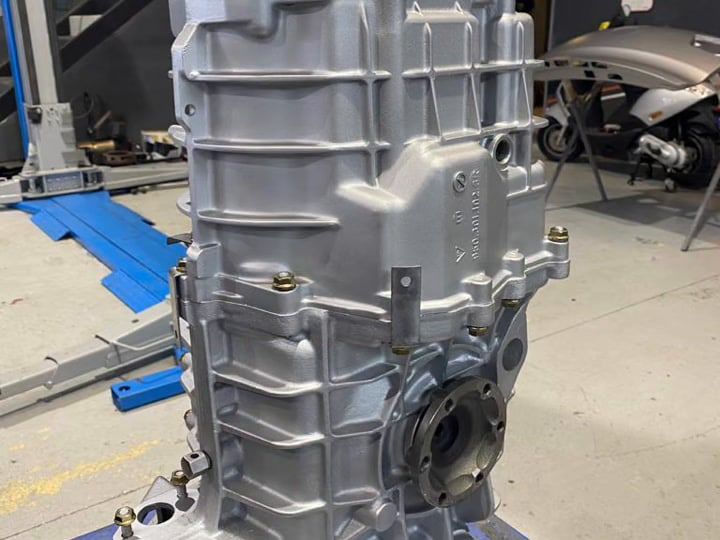
901, 915, G50: which gearbox does your Porsche have?
The Porsche gearbox evolved alongside the 911. Identifying the exact type, whose number is stamped on the casing, is the first step of any Porsche gearbox rebuild: parts, oil and adjustments all depend on it.
- Type 901: the first 911s, in four- or five-speed form; on the five-speed, first gear sits down and to the left, in a dog-leg pattern.
- Type 915: from the 1972 model year to the 1986 Carrera 3.2, including the Carrera RS 2.7; a stronger unit, built to follow the growth in engine capacity.
- 930 four-speed: the 911 Turbo’s gearbox, sized for the torque of the turbocharged engine, until 1988.
- G50 five-speed: from 1987 on the Carrera 3.2, with a hydraulically operated clutch; the 930 received it in 1989, its final year.
- 964: a G50-family gearbox on the Carrera 2, the G64 on the four-wheel-drive Carrera 4; Tiptronic offered from 1990.
- 993: six-speed manual derived from the G50, Tiptronic as an option.
- PDK: seven-speed dual-clutch from the 997 phase 2, eight speeds on the 992.
Why does the 915 gearbox ask for finesse?
The 915 is a good gearbox with its own habits. It uses Porsche’s own split-ring synchromesh, effective but sensitive to wear and to the oil it runs on. The second-gear synchros are known as the hardest-worked and the first to tire: second crunches when cold or on a quick downshift.
Its shift linkage has many wear points: the linkage bushes, the lever’s ball, the shift coupler at the gearbox input. A 915 described as vague often regains its precision through a rebuild of the linkage alone, without opening the gearbox. During a full rebuild, the workshop replaces worn synchro rings, inspects dogs, selector forks, bearings and differential — limited-slip included where fitted — then adjusts the linkage on reassembly.
G50 gearbox: what changed from 1987
The G50 transformed the way a 911 drives: firmer, more precise shifts, Borg-Warner-type cone synchros in place of the split ring, and a hydraulic clutch. It has its own inspection points: bearings, the synchros of the most-used gears, the condition of the differential, and the seals at the drive-shaft outputs.
On the 930 Turbo Cabriolet 1989 in our projects, the G50 was removed and rebuilt during the car’s restoration, together with the engine, the brakes and the suspension. The story of this model and of its two successive gearboxes is told on the Porsche 930 Turbo page.
Tiptronic and PDK: servicing and diagnosis
Tiptronic, the automatic gearbox with sequential control introduced on the 964, went on to equip the 993, the 996, the 997 phase 1, the Boxster and Cayman of the same period and the Cayenne. It lives on the cleanliness and level of its fluid: inspection, fluid change according to the manufacturer’s schedule, fault-code reading and adaptation values.
PDK, introduced on the 997 phase 2 and then extended to the 991, 992, Boxster, Cayman, Panamera and Macan, keeps the gear oil separate from the clutch and hydraulic oil on the 911. The workshop carries out fluid changes, diagnosis and adaptations; if the internal control unit is at fault, the options are set out for you before any decision.
924, 944, 928: the gearbox at the rear
Porsche’s front-engined cars place the gearbox on the rear axle, linked to the engine by a shaft running inside a rigid tube. A 944 or 924 transaxle is overhauled on the same principles as any other gearbox, but its removal and the inspection of the shaft and its bearings are part of the job, as is the clutch, which sits at the front, on the engine side.
Clutch, engine, gearbox: thinking of the whole
On a 911, the gearbox usually comes out together with the engine. It is the moment to inspect the Porsche clutch, flywheel, release bearing and operating mechanism, and to decide whether a Porsche engine rebuild is called for at the same time. The principles common to every make are set out on the gearbox rebuild page, and the workshop’s full range of work on the marque on the Porsche page.
Parts are genuine Porsche, of equivalent quality or reconditioned according to availability and your preference, with their origin stated. Photographs of the dismantled parts are sent to you before anything is ordered.