Ferrari upholstery: what the workshop makes
All Ferrari upholstery is made in our own workshop: seats, door cards, dashboard, centre console, headlining, carpets and their bindings. Every piece is first patterned from the old trim; hides and threads are chosen from samples, then the covers are stitched and stretched over the seat frames by hand.
The same care goes into a classic Ferrari and a recent one. Our general method, from materials to each stage, is described on the car upholstery page; here we concentrate on what is particular to a Ferrari interior.
Which leather for a classic Ferrari?
Many classic Ferraris left the factory trimmed in Connolly leather, from the English tannery that supplied a large part of the great marques at the time. That leather is no longer available as it was, so we select a hide whose grain, suppleness, thickness and colour come close to it, comparing it with a part of the interior that is still original.
Replacing is not always the right answer. Original leather that is patinated but sound can be cleaned, fed and repaired locally; on a collector’s car, it tells a story that new trim erases. We give you our view, and the choice between conserving and retrimming is yours, just as in a Ferrari restoration.
Daytona seats and carbon buckets: retrimming faithfully
The so-called ‘Daytona’ pattern, inherited from the 365 GTB/4 Daytona, is recognised by its pleated inserts and has been offered as an option on many later Ferraris. Reproducing it means matching the number, width and direction of the pleats; get those wrong and the seat loses its character at once.
The carbon-shell bucket seats of recent Ferraris need a different kind of attention. The shell is protected throughout, and the trim, in leather, Alcantara or a mix of both, is renewed without disturbing the mountings or the exposed carbon.
Ferrari sticky buttons and shrinking dashboard leather
On many Ferraris of the 1990s and 2000s, from the F355 to the 360 in particular, the soft-touch coating on switches, air vents and console parts breaks down with age and turns sticky. Cleaning products only mask it: the parts are removed, the failed coating is stripped and a new finish applied, or the part is replaced.
Heat takes its toll as well. On some models the leather bonded to the dashboard shrinks and lifts at the edges or around the vents, and the headlining can come away. Under the Riviera sun these faults appear quickly. The dashboard is then removed and re-covered, and the headlining remade in cloth or Alcantara, as original or as you prefer.
Embroidered prancing horse, contrast stitching and piping
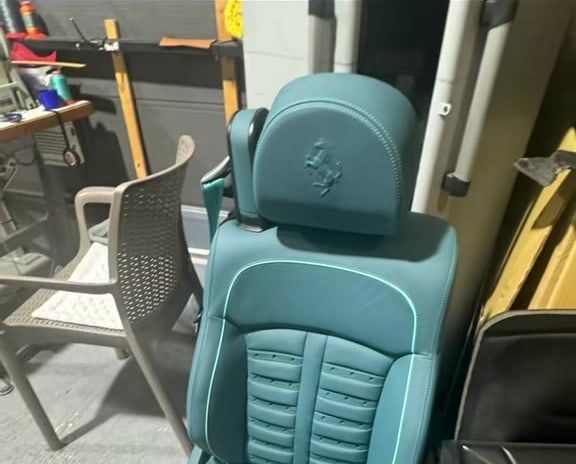
Details define a Ferrari interior: the prancing horse embroidered on the headrests, contrast stitching, piping, perforations, Alcantara inserts. They are best chosen together, with the body colour in mind.
The workshop trimmed the cabin of a Ferrari F12 in turquoise, a deliberately personal interpretation. For a classic, by contrast, we reproduce the original specification if that is what you want.
The 612 Scaglietti: blue-green leather to suit a two-tone body
On the Ferrari 612 Scaglietti in our workshop, the interior has been retrimmed in blue-green leather: covers sewn stitch by stitch and stretched by hand, pale piping, perforations, the prancing horse embroidered on the headrest, and a dashboard covered in leather.
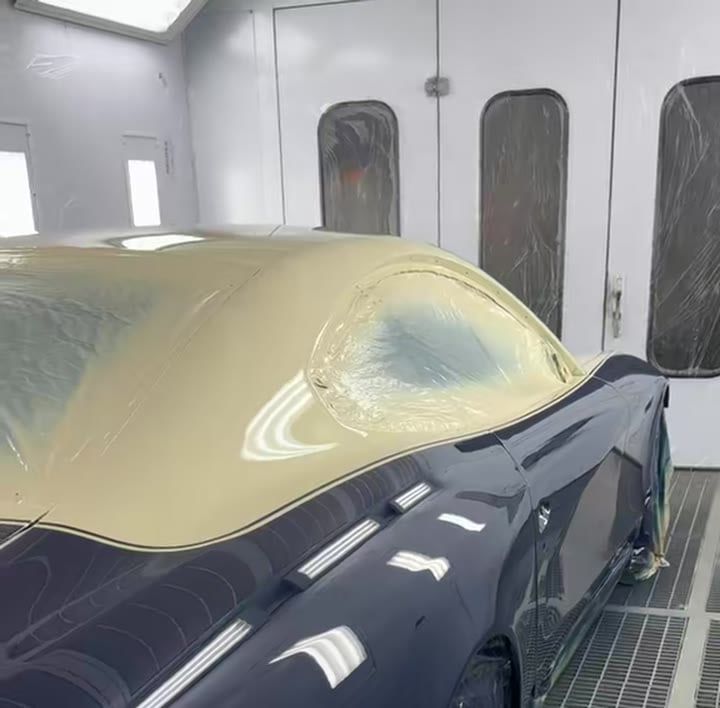
The colour was chosen to suit the car’s new night blue and cream paintwork, described on our Ferrari bodywork and paint page. For everything else the workshop does on the marque, see our Ferrari page.