Ferrari bodywork: which materials, in which era?
Before any work on Ferrari bodywork begins, it matters to know what the car is built from, because Maranello has changed material more than once. Many Ferraris of the 1950s and 1960s carry hand-formed aluminium bodies from the coachbuilders of the day, mounted on a tubular steel chassis; others pair a steel body with aluminium bonnet, doors or boot lid.
The earliest 308 GTBs, built from 1975 to 1977, have a glassfibre body, the much-sought ‘vetroresina’, before production switched to steel; the 328 keeps a steel body. With the 360 Modena in 1999, Ferrari moved its mid-engined berlinettas to an aluminium chassis and body, an approach carried on by later models such as the front-engined V12 612 Scaglietti. The story of those two classics is told on our page on the Ferrari 308 and 328.
Ferrari body repair on aluminium cars
Aluminium cannot be treated like steel. It responds differently to heat, holds its shape less readily and must be kept free of steel particles, which would later cause localised corrosion. The workshop therefore keeps dedicated tools and abrasives for aluminium, separate from those used on steel panels.
On a recent Ferrari with an aluminium structure, a body repair follows the methods laid down for that structure: panels are reshaped where they allow it and replaced where they do not, with shut lines and panel flushness checked on reassembly. On a glassfibre 308, damage is repaired by laminating, not by panel beating. Our wider approach is set out on the bodywork and panel repair page.
Rust on classic Ferraris: where to look
Steel-bodied Ferraris from the 1960s to the 1980s rust like other cars of their time, often where no one looks: sills, floor pans, wheel arches, the bottoms of the doors, the frames around the glass. Where steel meets aluminium, the joint is a weak point: electrolytic corrosion can take hold there and lift the paint along the seams.
Once the paint is bubbling, touching it in is not enough. The area is taken back to bare metal, its true condition assessed, the damaged metal replaced or rebuilt, then protected before paint. On a badly affected car, this metalwork becomes part of a full Ferrari restoration with the body stripped.
Ferrari paint: Rosso Corsa and the historic colours
Rosso Corsa, Italy’s racing red, is the colour everyone links with Ferrari, but it is far from the only one. Giallo Modena, Nero Daytona, Argento Nürburgring and Blu Tour de France belong to the marque’s history too, and a single colour name has been mixed to more than one formula over the decades.
To match a Ferrari exactly, we start from its paint code, then compare test panels against an untouched part of the car in daylight. A classic finished in solid lacquer is not resprayed like a modern Ferrari in base coat and clear: the technique follows the period, unless you choose a personal interpretation. Our car paint and respray page describes each stage, from primer to final polish.
Two-tone paint and coachlines: the 612 Scaglietti
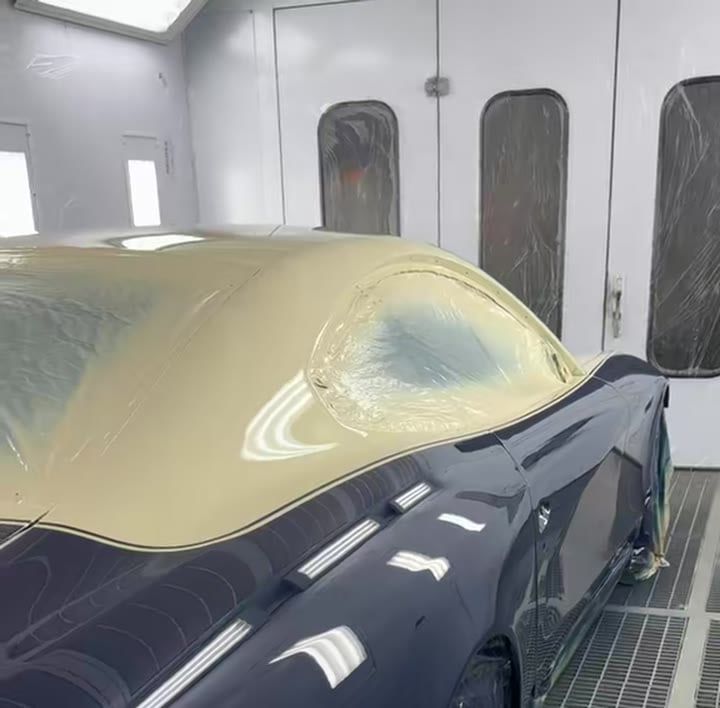
A two-tone finish lives or dies on one line. On the Ferrari 612 Scaglietti in the workshop, which arrived in silver grey, bumpers and lights were removed and the glass protected before the car was primed in the booth. The split between the two colours was marked out in tape before the first coat.
Bonnet, boot lid and doors were painted separately in night blue, the roof in cream, and the colour split runs right along the coachline. The car’s interior was retrimmed in blue-green leather to suit its new livery, as described on our Ferrari upholstery page.
Shields, grilles and paint protection film
A fine paint finish is also judged by its details. Scuderia shields on the wings, prancing horse badges, script and grilles are removed before painting and refitted afterwards rather than masked; tired grilles and trim are refurbished.
On a Ferrari that is driven, clear paint protection film can be applied to the areas most exposed to stone chips, once the paint has fully cured. Photographs are enough for a first opinion: request a quote and we will reply item by item.
- Removal of wing shields, badges and grilles
- Refurbishment of grilles and exterior trim
- Shut lines and panel fit checked on reassembly
- Clear protection film on exposed areas, on request