Which Ferraris have a cambelt?
A Ferrari cambelt change concerns three families of engines. First the mid-engined V8s, from the 308 to the 360 Modena. Then the flat-twelves, from the Testarossa to the F512 M. Finally the front-engined V12s of the following generation, from the 456 GT to the 612 Scaglietti. On these engines the camshafts are driven by toothed belts, generally one per bank of cylinders.
With the F430, Maranello’s V8s moved to chain-driven camshafts, as did the models that followed. For any specific car, we check its engine configuration in the technical documentation before quoting.
- Mid-engined V8s: 308, 328, Mondial, 348, F355, 360 Modena
- Flat-twelves: Testarossa, 512 TR, F512 M
- Front-engined V12s: 456 GT and 456M, 550 Maranello, 575M Maranello, 612 Scaglietti
Why change the belts on a Ferrari that is rarely driven?
A toothed belt is made of reinforced rubber. Over the years the rubber hardens, cracks across the back and at the root of the teeth, and the reinforcement loses its strength, even if the car never leaves the garage. That is why the manufacturer’s programme sets a deadline by time as well as by mileage, whichever is reached first. A Ferrari that only comes out on a few fine days a year must therefore have its belts changed like any other.
On these engines, a belt that snaps or jumps a tooth lets the pistons strike the valves. The damage then far exceeds the cost of a belt service: valves, guides, sometimes cylinder heads and pistons. Tensioner pulleys age too: a bearing that seizes or develops play can throw a brand-new belt off its path.
How is a Ferrari belt service carried out?
The work begins with gaining access to the engine, which varies greatly from one model to another. The timing marks are then checked and the shafts locked with the correct tooling before anything is removed. The following items are replaced or checked, according to the manufacturer’s programme and the condition found:
- Cambelts, always replaced as a set
- Tensioner and idler pulleys, with their bearings
- Camshaft and crankshaft oil seals, when they weep or when access makes it sensible
- Water pump, depending on its condition and the model
- Auxiliary belts and their pulleys
- Timing and tension verified with the engine turned by hand, followed by a road test
348 and F355: why the engine usually comes out
Depending on the model, access ranges from working through the engine bay to removing the entire powertrain. On the 348 and the F355, the engine and gearbox are generally lowered out of the car for this job. That makes it a major operation, but it gives a full view of what stays hidden the rest of the time: engine mounts, hoses, exhaust manifolds, clutch, wiring looms and leaks.
This is why a cambelt change is often combined with other work that shares the same access. Before starting, we provide a detailed, itemised quotation in which any additional work is listed separately, for you to accept or decline. On the Ferrari 308 and 328, with their transverse engine, the approach is different and described on their page.
The workshop’s Testarossa: a timing system seen from inside
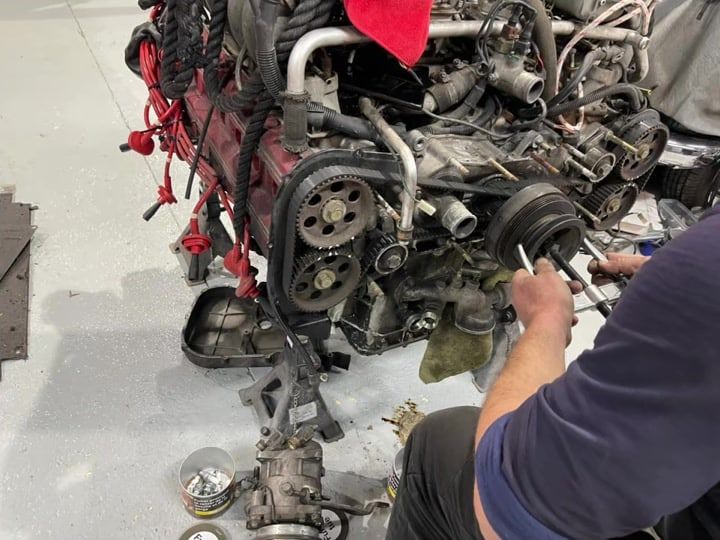
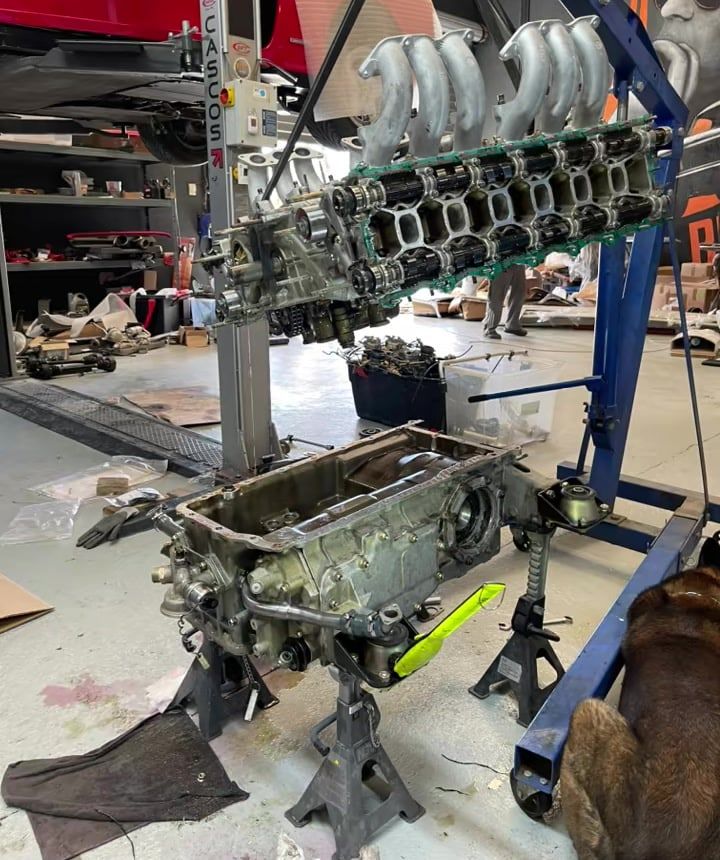
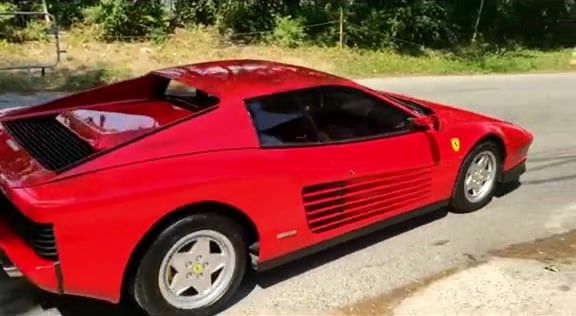
The Testarossa’s flat-twelve drives its four camshafts by belts. On the Testarossa whose engine the workshop rebuilt, the engine was removed and fully dismantled: the timing system came off with everything else, the parts were reconditioned, then the engine was reassembled, refitted and the car road-tested.
A project of this kind belongs to engine rebuilding rather than routine servicing, but it shows why a timing system is judged part by part. The particularities of the Testarossa, 512 TR and F512 M are set out on the page dedicated to the Ferrari Testarossa.
Cambelts and history: what the invoice should say
The date of the last belt change is one of the first questions asked when a belt-driven Ferrari is sold. A detailed invoice stating the date, the mileage, the parts and their origin protects the car’s value. Where that record is missing, prudence says the belts should be treated as due.
The car’s other deadlines — fluids, brakes, F1 gearbox — are covered on the Ferrari servicing page. For an initial estimate, you can request a cambelt quotation from photos and videos; the car is then examined before any commitment.