Ferrari Testarossa history: the versions from 1984 to 1996
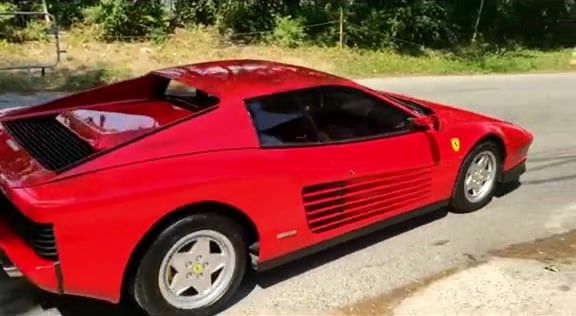
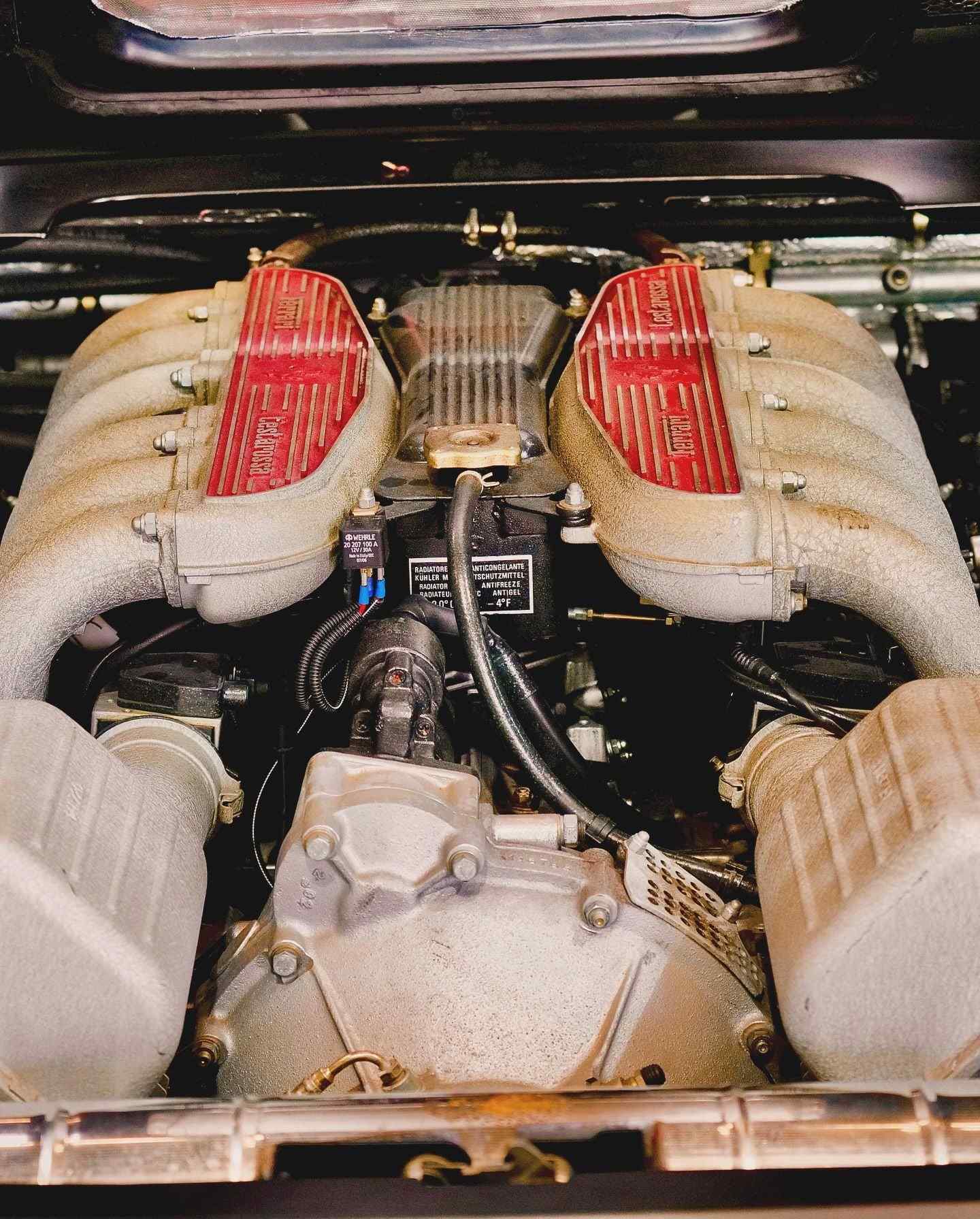
The Ferrari Testarossa was unveiled at the 1984 Paris Motor Show and built until 1991. Styled by Pininfarina, it succeeded the 512 BBi and kept its layout: a flat-twelve mounted amidships, sitting above the gearbox. The name recalls the 250 Testa Rossa of the 1950s, and the engine’s cam covers are painted red.
The 4.9-litre engine has four valves per cylinder. Strictly speaking it is a 180-degree V12 rather than a true boxer, since opposing cylinders share a crankpin. It is fed by Bosch K-Jetronic injection and paired with a five-speed manual gearbox. The long side strakes, the car’s signature, feed two radiators mounted in the flanks ahead of the rear wheels, rather than in the nose.
- Testarossa (1984–1991): the earliest cars have a single, high-mounted mirror on the driver’s windscreen pillar, hence the nickname ‘monospecchio’; the early centre-lock wheels later gave way to five-stud fixing;
- 512 TR (1991–1994): revised engine set lower in the chassis, Bosch Motronic engine management, restyled nose and cabin;
- F512 M (1994–1996): the final evolution, recognisable by its fixed, faired-in headlamps in place of the pop-ups.
Ferrari Testarossa problems: what to look for
A sound Testarossa is a robust car, but it has aged like every Ferrari of its generation. Before recommissioning, buying or servicing one, the workshop looks first at:
- the cambelts: the four camshafts are belt-driven, and the last belt and tensioner change should be on an invoice; with no record, treat it as due;
- cooling: side radiators clogged with leaves and debris, fans, hoses;
- the K-Jetronic injection: cold starting, fuel pressure, fuel lines and unions, which also matter for safety;
- oil leaks around the sump and cam covers, whose red crackle finish flakes with age;
- the clutch and gear linkage; second gear can baulk when cold, as on many gated Ferraris;
- electrics and cabin: relays, earths, dashboard leather that shrinks, switchgear whose soft coating turns sticky.
Why take the engine out of a Testarossa?
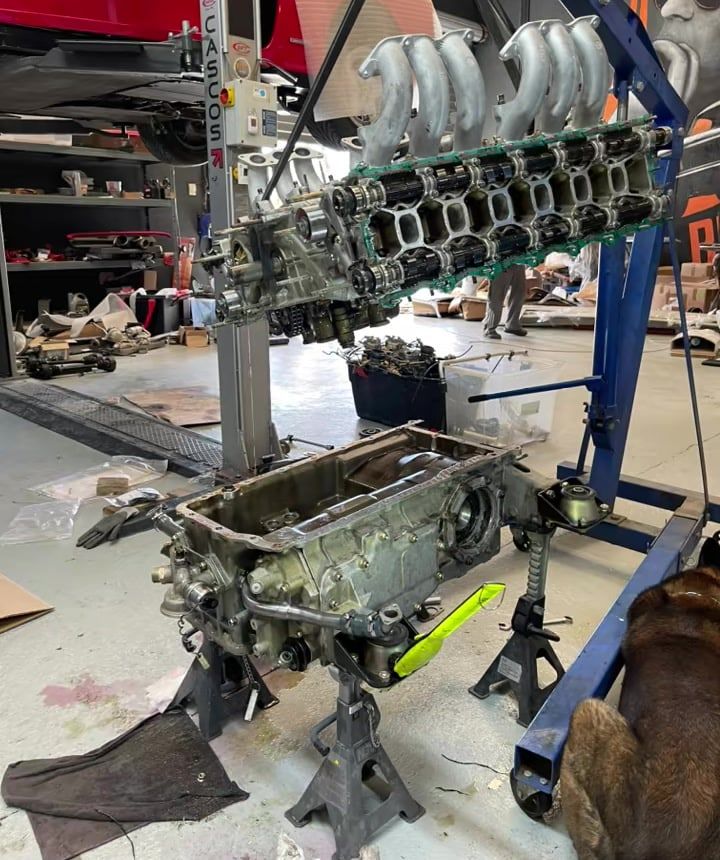
Engine and gearbox form one compact unit in a bay where every centimetre is used. For some heavy jobs — the clutch, a thorough belt and seal overhaul, leaks at the back of the engine — dropping the engine and gearbox together is often the safest route. This is the well-known ‘engine-out service’.
We do not recommend it by default: the estimate separates what needs the engine out from what can be done in the car. Once the engine is out, it makes sense to group everything that shares the same access: belts, tensioners, seals, engine mounts, hoses, clutch. How a belt service is carried out is explained on our Ferrari cambelt service page.
Our workshop’s Testarossa: a flat-twelve fully rebuilt
The red Testarossa whose engine we rebuilt arrived in Mougins with a failed engine. The flat-twelve was removed, then stripped down to the bare block: timing, cylinder heads, injection, ancillaries. Every part was cleaned, checked and labelled; those that needed it were refurbished, such as the inlet manifold.
The engine was then reassembled and refitted into a cleaned engine bay, and the car was road-tested. Work of this kind is an engine rebuild rather than routine servicing: it shows the real condition of every component, and that condition, found part by part, is what the estimate is built on.
Servicing a Testarossa: what really matters
A Testarossa is serviced to Ferrari’s programme for the model, by time as well as mileage: a car that covers few miles still ages, and so do its belts, hoses and fluids. The engine has dry-sump lubrication, so the oil level is checked following the specified procedure, with the engine warm.
At every visit we also check the side radiators, the fuel system, the brakes, the suspension and its bushes. On the 512 TR and F512 M, the engine management is also read with diagnostic equipment. Routine work is covered on our Ferrari servicing page.
Bodywork, trim and full restoration
The Testarossa’s line depends on precise details: straight, even strakes, the rear grille, consistent gaps around the large panels. The body combines steel and aluminium depending on the panel, and the joins need watching, as corrosion settles there beneath the paint. A full restoration starts with an inspection of the shell and numbers, and follows the method set out in Ferrari restoration.
Inside, the leather of the seats, door panels and dashboard is entirely re-trimmed in our workshop, either to the original specification or in a combination of your choosing.
What our workshop does for your Testarossa
Based in Mougins since 2017, our independent workshop handles servicing, mechanical work, bodywork, trim and full restoration of the Testarossa, 512 TR and F512 M. One team follows the car from the first inspection to the final road test; you receive photographs of the key stages, and no additional work is carried out without your approval.
A first opinion is possible from photographs and videos: request an estimate. For a car further afield, transport can be arranged on request, within France and across Europe. The other Ferraris we look after are on our Ferrari page.