Which Ferraris can an independent specialist look after?
No two Ferraris are serviced in quite the same way. A mid-engined berlinetta, a front-engined V12 grand tourer and a Testarossa share almost nothing in layout, access or in the work the factory schedules for them. An independent Ferrari specialist must first place the car in its family, then in its generation, before discussing any work at all.
The workshop looks after every one of these families, from collectable classics to recent models.
- Mid-engined V8s: 308 and 328, Mondial, 348, F355, 360 Modena, F430, then the 458 Italia, 488 and F8 Tributo
- Front-engined V8 grand tourers: California, Portofino, Roma
- Front-engined V12s: 365 GTB/4 Daytona, 456 GT, 550 Maranello and 575M, 599 GTB, 612 Scaglietti, F12berlinetta, 812 Superfast
- Mid-mounted flat-twelves: Testarossa, 512 TR and F512 M
- Four-seat Ferraris: Mondial, 456 GT, 612 Scaglietti, FF, GTC4Lusso
Carburettors, injection, F1 gearboxes and dual-clutch
Ferrari has gone through four mechanical eras, and each calls for its own skills. Carburettor classics with Weber carburettors, such as the Daytona or the early 308s, are set up by ear and by instrument: balancing the chokes, ignition timing, mixture. Then came Bosch K-Jetronic mechanical injection, used on the fuel-injected 308s and the Testarossa, followed by electronic engine management, read with a suitable diagnostic tool.
From the F355 F1 onwards, the automated gearbox operates the clutch through a hydraulic circuit: pump, pressure accumulator, actuators and self-learning procedures all become part of routine servicing. The dual-clutch gearboxes introduced on the California and then the 458 Italia follow a different logic again. The clutch of an F1 or dual-clutch Ferrari has its own page, setting out what is checked and what is replaced.
Each Ferrari craft, its own reference page
On a Ferrari, a handful of operations account for most of the questions owners ask. The service itself and its known weak points — fluids, exhaust manifolds, cooling, carbon-ceramic brakes — are covered under Ferrari servicing, V8 and V12. Belt replacement, which concerns many models up to the 360 Modena as well as the front-engined V12s from the 456 to the 612, is explained on the page devoted to the Ferrari cambelt service.
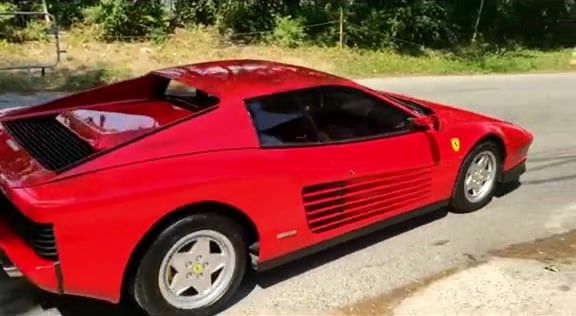
For deeper work, classic Ferrari restoration, Ferrari bodywork and paint and Ferrari upholstery, carried out entirely in the workshop, each have a page of their own. Two models have theirs too: the Ferrari Testarossa and its successors, and the Ferrari 308 and 328, GTB berlinettas and GTS targas with a transverse mid-mounted V8.
Two Ferraris that have passed through the workshop
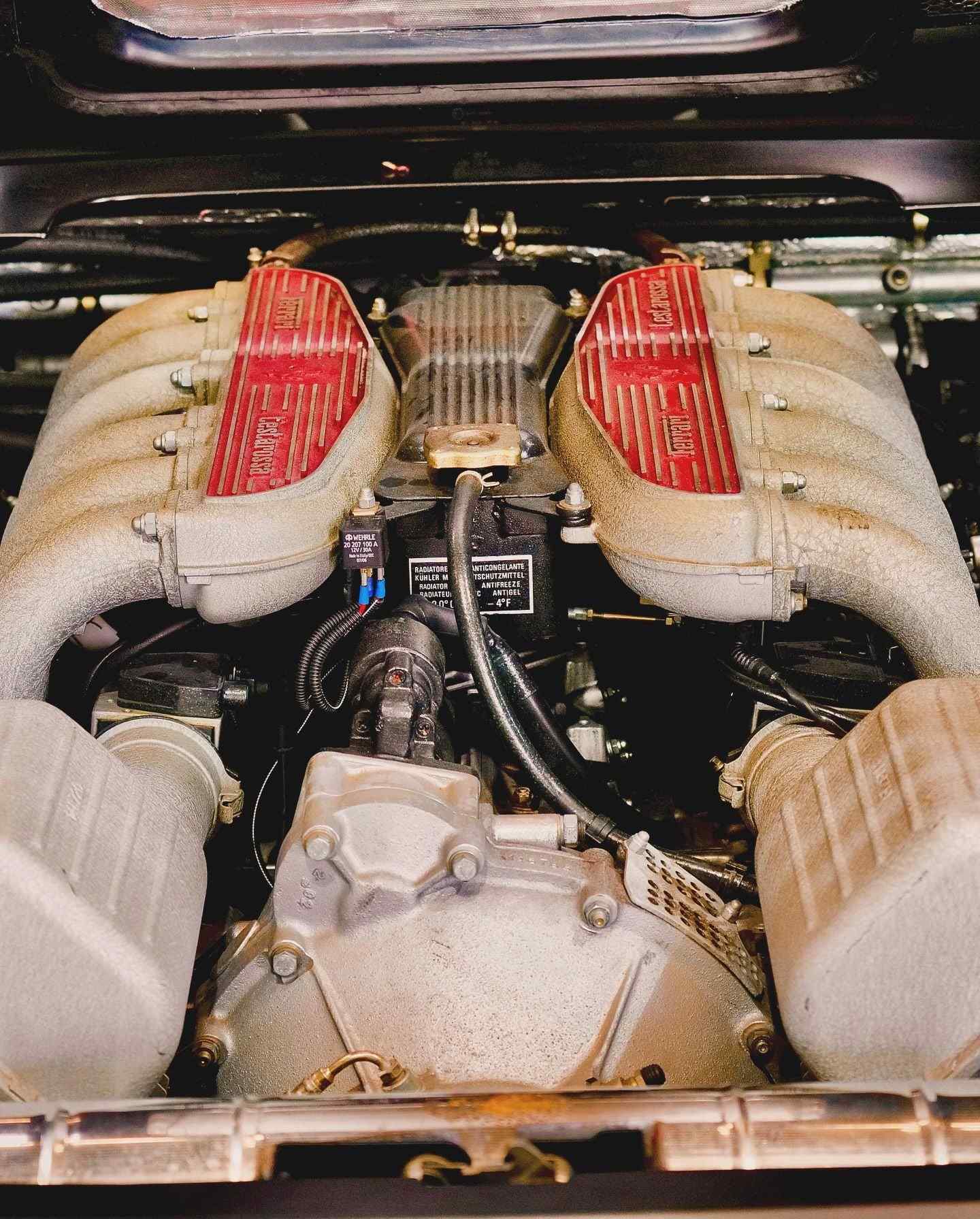
The workshop’s Testarossa received a complete rebuild of its flat-twelve: engine removed, fully dismantled, parts reconditioned, reassembled, refitted and road-tested. It is the kind of project where the whole engine is laid bare, from the cambelts to the crankshaft, and every component is judged on its actual condition.
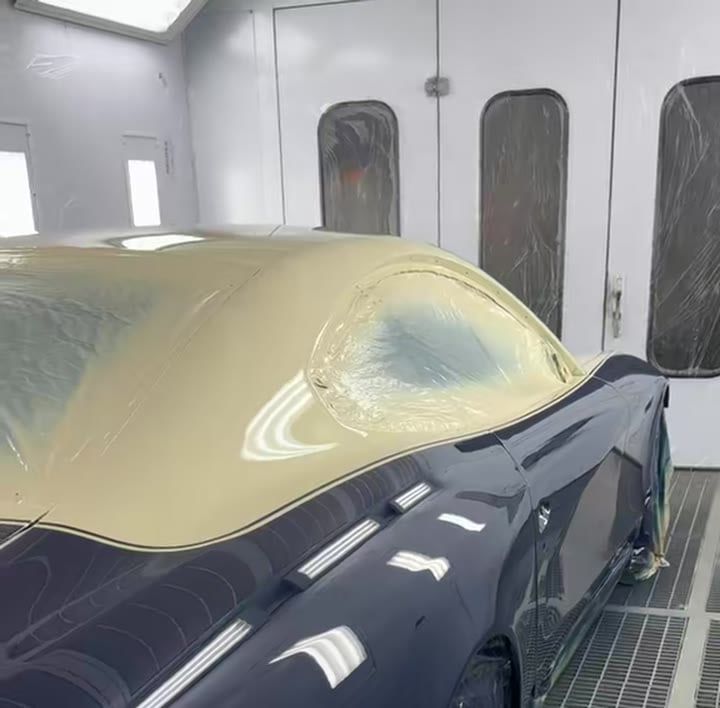
The Ferrari 612 Scaglietti, a four-seat V12 grand tourer, has been repainted in a midnight blue and cream two-tone in place of its original silver grey, and trimmed in blue-green leather with an embroidered prancing horse. The turquoise cabin of an F12berlinetta was also made in the workshop: staying faithful to the original or reinterpreting it is always your choice.