Mercedes 280 SL Pagoda restoration: what to watch for
Mercedes Pagoda W113 restoration: sills, floorpans, chassis legs, Bosch injection, fake 280 SLs and misleading filler. What to know before the work begins.
The W113-series Mercedes-Benz SL owes its nickname to its hardtop. The gently dished roof recalls the curve of a pagoda. The design shows rare restraint, the build quality is remarkable, and the car drives with a smoothness that has not aged. That is precisely why a Pagoda deserves a rigorous restoration: beneath a fine coat of paint, a tired shell can stay hidden for a long time.
Here is what we examine at our Mougins workshop, on the French Riviera, before any Mercedes Pagoda restoration, and the pitfalls we meet most often.
Three versions, one line
The W113 was built from 1963 to 1971, in three versions: 230 SL, 250 SL and 280 SL. All use a straight-six fed by Bosch mechanical fuel injection. The 280 SL, the last and the most sought after, shares most of its body with its predecessors. All three could be ordered with the “pagoda” hardtop, the soft top, or both.
This closeness between versions explains one of the traps of the market, to which we will return.
The shell: the heart of the matter
On a Pagoda, the mechanical work is rarely the largest part of the bill. The body almost always is. Some of the opening panels are aluminium, but the structure is steel, and that steel rusts where people look least.
Areas to inspect
- the sills, along their whole length;
- the floorpans, at the front and under the seats;
- the front and rear chassis legs, which carry the structure;
- the jacking points;
- the wheel arches and the lower edges of the wings;
- the boot floor and the spare wheel well.
A Pagoda that looks sound from outside may have floors patched with plate, or weakened chassis legs. Only an inspection on the lift, then a bare shell, can settle the question.
The filler trap
Two materials must be told apart. Seam sealer protects welds and panel joints: it is essential. Body filler is meant to smooth a surface; applied thickly, it can hide a hole, rotten metal or a hasty repair. Fresh, glossy paint on a shell that has never been stripped calls for caution. A paint thickness gauge gives a first indication, but only stripping tells the whole story.
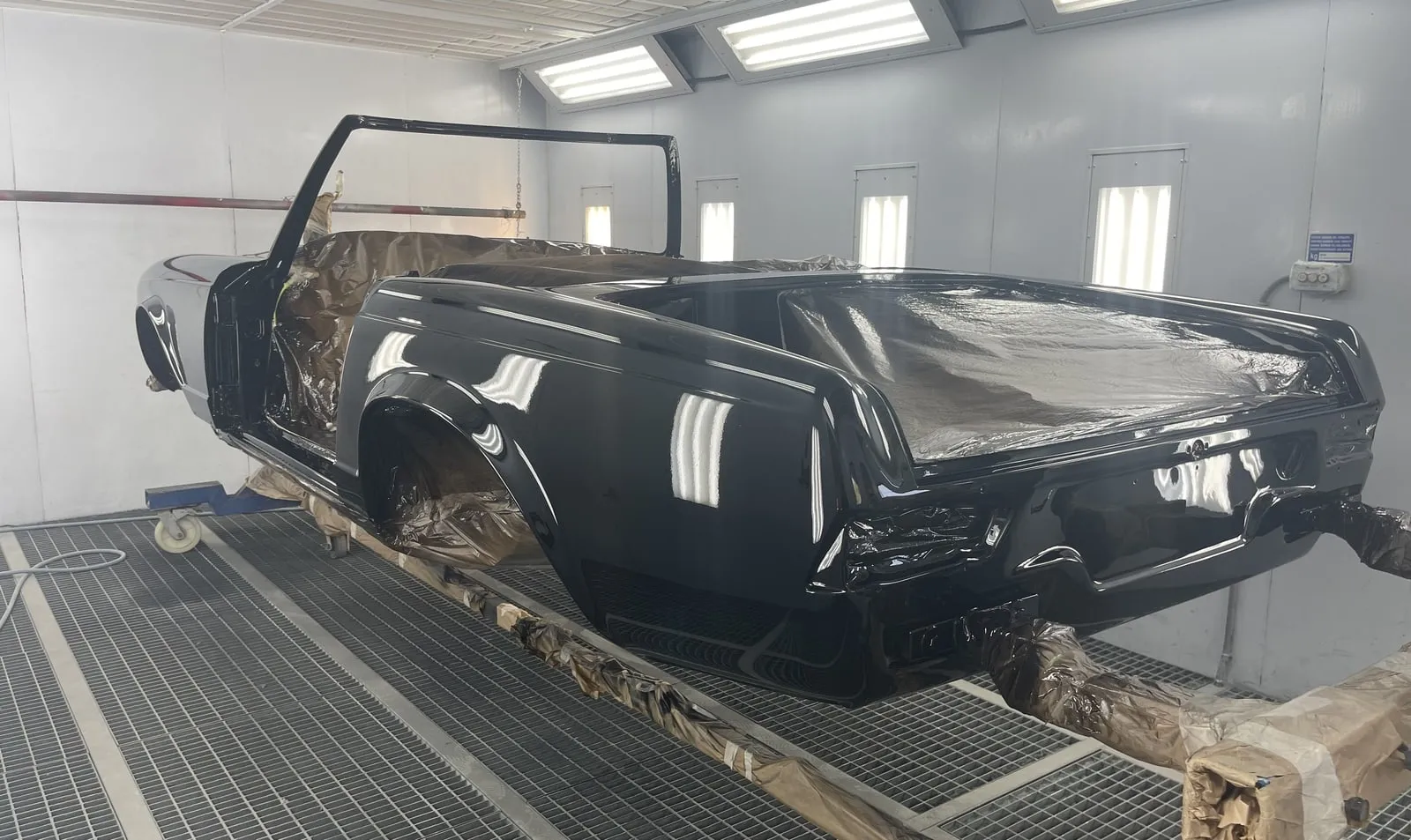
On the black Pagoda restored in our workshop, the shell was stripped bare on its pallet. The floor and tunnel went into primer, and every weld received a new bead of seam sealer before the black lacquer was laid down in the booth. That work, invisible once the car is reassembled, is what makes a restoration last.
Mechanicals
Bosch mechanical injection
The W113’s Bosch injection is reliable when it is properly set up. It is far less so in hands that do not know it. A Pagoda that starts poorly, hesitates when cold or drinks too much often needs nothing more than precise adjustment. Sometimes the pump or the injectors need overhauling. Before concluding that a rebuild is due, we begin with a diagnosis.
Engine, gearbox and running gear
The six-cylinder is robust. Smoke from the exhaust, low oil pressure or timing noise point towards opening the engine. The gearbox, manual or automatic, is judged on the road. At the front, the subframe, arms and bushes age; at the rear, the swing axle calls for careful setting up. On our 280 SL, the subframe and suspension arms were lacquered black and the front axle rebuilt before reassembly.
Hardtop and soft top
The “pagoda” hardtop is a component in its own right. Its seals, its fixings and the condition of its roof panel need checking, as do any signs of corrosion along its edges. The soft top is judged on its fabric, its tension and its mechanism. A car that comes with its original hardtop and a sound hood spares itself two projects, and keeps its coherence.
Traps in the market
The fake 280 SL
A 230 SL or a 250 SL looks very much like a 280 SL. A badge can be changed in minutes. Before any purchase, the body and engine numbers must match the version advertised. The factory data card, which can be requested from Mercedes-Benz Classic, confirms the version, the colour and the original equipment.
The disguised shell
A recently repainted Pagoda with new chrome and a refreshed interior may hide a structure that has never been dealt with. The reverse is also true: a car with a modest presentation but a sound body is often the better starting point. The quality of the shell counts for more than the shine of the paint.
The file
Invoices, photographs of an earlier restoration, a record of previous owners: a complete file is reassuring. An old restoration with no photographs proves nothing. Our classic car paperwork page answers the most frequent administrative questions.
The interior
A Pagoda’s cabin is simple and supremely elegant. Seats, door cards, dashboard and boot can all be retrimmed in our workshop. On the black 280 SL, the interior was redone in cognac leather with sewn pleats, right down to the trimmed boot. Whether to keep or replace original upholstery is always worth asking; we discuss it in our article on original leather upholstery, restore or retrim.
A Pagoda restored in our workshop
The Mercedes-Benz 280 SL Pagoda on our Our Work pages brings these stages together. It arrived on a flatbed and was dismantled piece by piece. The shell was stripped bare, the floor sealed, then the black lacquer applied in the booth. The six-cylinder was detailed, the front axle rebuilt, the interior trimmed in cognac leather. Once complete, it left to rejoin its owner.
How we work
A Pagoda restoration begins with a serious inspection. You send us photographs, we ask our questions, then a detailed quotation reaches you. It is confirmed once the car has been examined at the workshop. All our work is quoted individually: no two Pagodas are alike. You then follow the project in photographs, stage by stage, whether you live on the Riviera or elsewhere in Europe; our European clients page explains how a project followed from a distance works.
To learn more about our work, see full restoration and our Mercedes-Benz page.
In closing
A Pagoda is judged from underneath. The line draws you in; the shell decides. If you are considering a restoration or a purchase, you are welcome to write to us, or to request a quotation from a few photographs.
The Original Classic & Luxury Cars team