Which parts can be rechromed on a classic car?
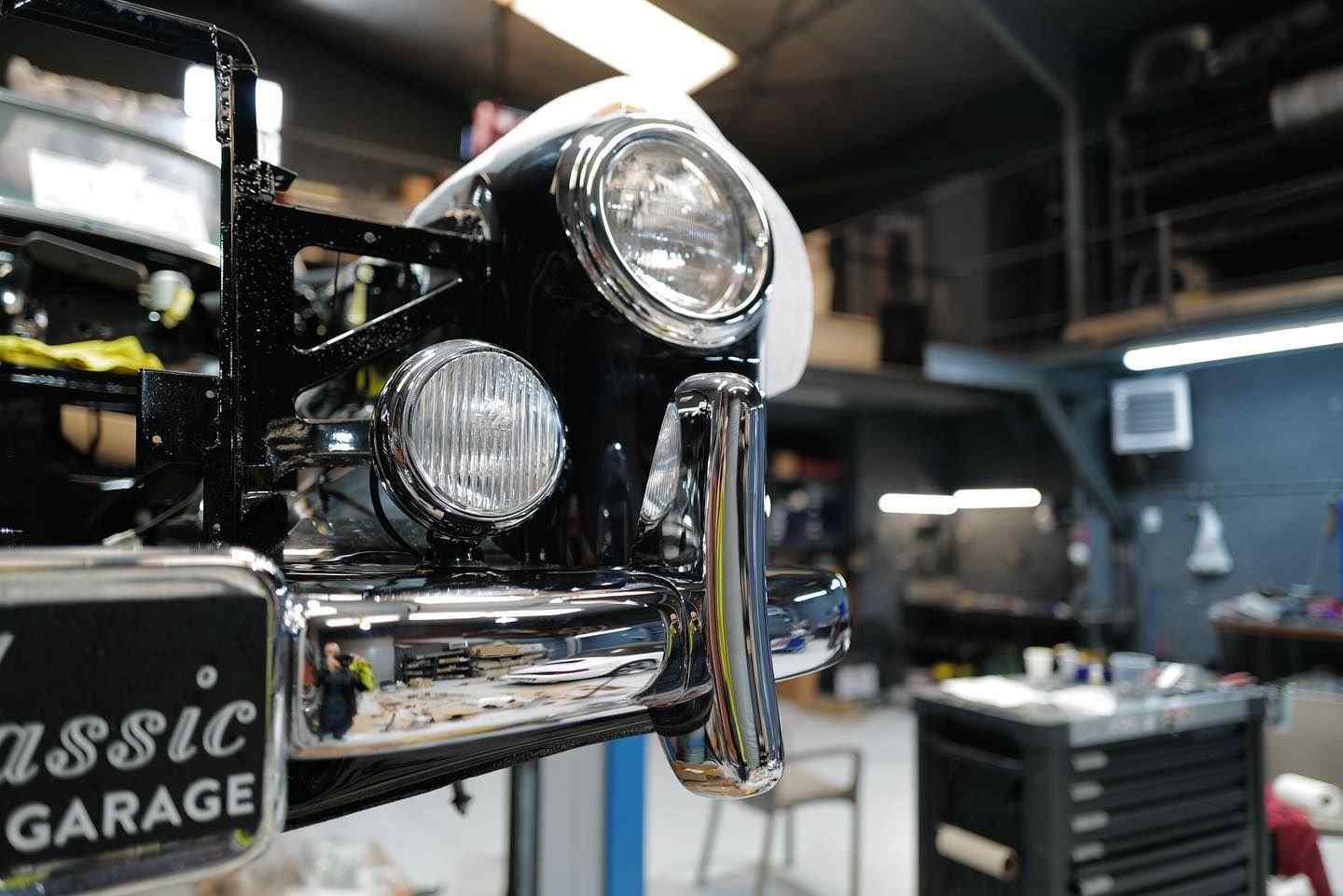
Rechroming applies to bright parts in steel, brass or zinc alloy: bumpers and overriders, grilles, hubcaps, headlamp and tail-lamp surrounds, door handles, trim strips, bezels and dashboard details. The workshop handles the rechroming from removal to refitting, as part of a full restoration or for just a few parts.
The Mercedes that pass through the workshop, Ponton, 220 SEb Cabriolet, 280 SL Pagoda or 190 SL, show how much space chrome occupies: grille, bumpers, hubcaps and beading frame every volume. On a Mercedes 190 SL or a W113 Pagoda, tired chrome is enough to age the whole car, however good its paint.
How does decorative chrome plating work?
The bright chrome of a classic car is not a single layer. Decorative chrome plating builds up three electroplated deposits, each with its own job:
- copper, which bonds to the base metal and is polished to remove the last irregularities;
- nickel, which provides most of the brilliance and the resistance to corrosion;
- chromium, a very thin layer that gives the slightly blue tint, surface hardness and resistance to tarnishing.
Triple chrome, hard chrome, chrome effect: not the same thing
This copper, nickel and chrome build-up is what is usually called triple chrome plating. It has nothing in common with hard chrome, a thick technical coating meant for mechanical parts, nor with chrome-effect paints and films, which only imitate the look and age quite differently.
It is the quality of each stage, not the thickness of the final chrome, that gives depth to the reflection and life to the part. Poorly polished copper shows through the nickel; nickel that is too thin lets corrosion return.
Removal, stripping and straightening
Good chrome starts with methodical removal. Each part is photographed in place, labelled and listed with its fixings and seals, and the surrounding paint is protected. Fasteners seized after decades are dealt with patiently rather than by force.
The old plating is then stripped back to the metal. The part is straightened, whether a bumper marked by a knock or a bent trim strip, cleaned of corrosion and polished. Chrome hides nothing: it magnifies every dent, scratch and pit left beneath it.
Zinc die-cast parts (Mazak or Zamak), common for handles, badges and some surrounds, need particular care: their corrosion forms deep pits and the metal does not tolerate aggressive polishing. When a part is too far gone, we tell you, and the answer may be a replacement part, original or reproduction, with its origin stated.
Chrome, stainless steel or polished aluminium
Not every bright part on a classic car is chromed. Many trim strips, window surrounds and beadings are stainless steel or aluminium, sometimes anodised. These parts are not rechromed: they are straightened, refinished and polished in their own material.
Headlamp reflectors call for yet another process, vacuum metallising. Identifying each material before starting avoids treating a part the wrong way and keeps the look the manufacturer intended: blue-tinted chrome here, softer stainless steel there.
Inspection, refitting and chrome care
When the parts come back, each one is inspected in full light: even brilliance, no pits or blisters, coverage in recesses and corners, clean edges, clean threads and mounting faces. A part that does not meet this standard is not refitted.
Refitting uses new seals where the old ones have hardened, suitable fixings and spacers that keep the chrome off the paint. On a resprayed car the order matters: the brightwork goes back once the paintwork has been polished, so neither marks the other.
Fresh chrome is simple to look after: rinse with clean water, dry carefully, use a non-abrasive polish and an occasional thin coat of wax. Sea air, winter road salt and a damp, unventilated garage are its real enemies. The quote lists, part by part, what is rechromed, polished or replaced, and nothing is added without your agreement.