Land Rover Defender: from the Series to the 90 and 110
In 1983 Land Rover replaced the Series III with the One Ten, followed in 1984 by the Ninety. The silhouette barely changed, but almost everything underneath moved on: coil springs instead of leaf springs, permanent four-wheel drive with a lockable centre differential, and front disc brakes. The numbers refer to the wheelbase in inches, rounded up in the case of the 90.
The Defender name only arrived in 1990, to set the model apart from the Discovery launched the year before. Production at Solihull ended in January 2016, after more than three decades without a change of principle. Any Defender restoration therefore starts with three simple questions: which generation, which wheelbase, which engine. The range breaks down as follows:
- 90, the short wheelbase, as Hard Top, Station Wagon, Soft Top or Pick-Up;
- 110, the long wheelbase, as Station Wagon, Hard Top, Pick-Up or Crew Cab;
- 130, originally called the 127, mostly as a Crew Cab with a load bed;
- the Defender launched in 2020 is an entirely different vehicle, with an aluminium monocoque: it belongs with the servicing of recent Land Rovers.
Which engines were fitted to the Defender?
Before 1990 the 90 and 110 used four-cylinder petrol and diesel engines carried over from the Series, including a 2.5-litre turbodiesel, as well as the Rover V8. Then came the engines that now shape a Defender’s value and character:
- 200Tdi (1990): 2.5-litre four-cylinder direct-injection turbodiesel, fully mechanical;
- 300Tdi (1994): its development, paired with the R380 manual gearbox; its cambelt deserves particular attention;
- Td5 (1998): 2.5-litre five-cylinder with electronically controlled unit injectors; oil wicking into the injector wiring loom is a known fault;
- the Ford-derived 2.4-litre known as the “Puma” (2007), with a six-speed gearbox, then a 2.2-litre from 2012;
- the aluminium Rover V8: 3.5 litres in the early 90 and 110, larger capacities in some special editions and export versions.
Where does a Defender rust? Chassis, bulkhead and aluminium
The Defender’s body panels are aluminium alloy, but they sit on a steel ladder chassis and are built around a steel front bulkhead that carries the windscreen, the dashboard and the front doors. That is where the true condition of the vehicle is decided:
- the chassis: rear crossmember, body outriggers, spring and suspension arm mountings;
- the bulkhead: windscreen pillars, footwells, chassis mounting points; it can be repaired in sections or replaced;
- galvanic corrosion wherever aluminium meets steel: door frames, fixings, reinforcements;
- the windscreen frame, the hinges and the underside of the rear body.
How does a Defender restoration work?
A Defender that looks sound can hide a tired chassis under paint or underseal. The workshop therefore inspects it on the lift, once cleaned, and then draws up a detailed quote, item by item; a first opinion is also possible from photographs and videos sent remotely.
Depending on condition, the work ranges from localised treatment to a full body-off restoration: body separated from the chassis, chassis repaired or replaced, bulkhead restored, aluminium panels straightened, then protection and paint. The mechanical side — engine, gearbox, transfer box, axles, brakes, steering — is overhauled or rebuilt according to what the strip-down reveals. The general approach is described on the classic car restoration page.
You receive photographs of the key stages, and no additional work is undertaken without your approval. Parts are original, of equivalent quality or reconditioned, with their origin stated.
Restomod or original: which Defender do you want?
The Defender lends itself particularly well to bespoke preparation, provided it stays true to the vehicle: more comfortable seats, sound deadening, lighting, wheels, colour, cabin details. The workshop can equally return a vehicle as closely as possible to its factory specification; the choice is yours.
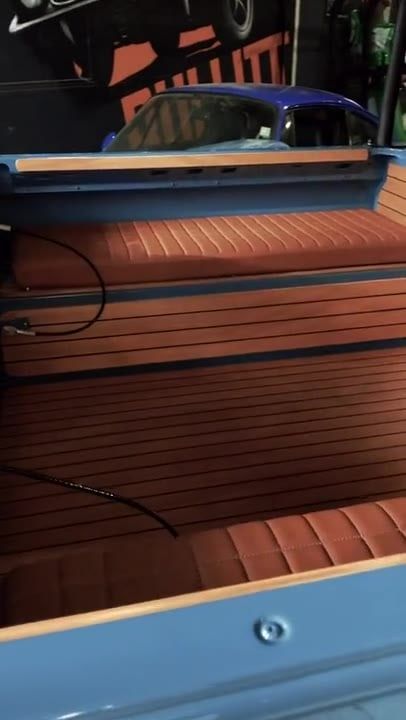
All upholstery is made in-house. A Defender trimmed in cognac leather and teak, completed in Mougins, shows the spirit of it: a warm, hard-wearing interior that respects the simplicity of the model. Materials, stitching and finishes are presented on the car upholstery page.
Servicing a classic Defender
A well-kept Defender ages slowly. Servicing follows the manufacturer’s programme, with particular attention to leaks, ball joints and bushes, brakes, axles, the transfer box and the timing drive of the engine concerned. The specifics of each generation, from the Tdi engines to recent Range Rovers, are set out on the Land Rover and Range Rover servicing page.
The Defender shares with the Mercedes G-Class a separate chassis designed to last; both are restored with the same rigour. The whole marque, from the Series to current models, is covered on the Land Rover page. If your vehicle is far from Mougins, transport can be arranged on request, within France and across Europe.