From W460 to W463: the classic G-Class generations
The G-Class was born in 1979 from a collaboration between Mercedes-Benz and Steyr-Daimler-Puch, which assembled it in Graz, Austria; in some countries it was sold as the Puch G. The principle would never change: a separate ladder-frame chassis, two rigid axles, flat body panels and doors with exposed hinges.
The W463 stayed in production until 2018, when an entirely new G-Class replaced it under the same silhouette. This page covers the earlier generations:
- W460, from 1979: the first series, short or long wheelbase, open-top, station wagon or panel van, with four-, five- or six-cylinder petrol and diesel engines; four-wheel drive is engaged on demand;
- W461: the professional version, plainer, intended for armed forces, public services and working use;
- W463, from 1990: the luxury G-Class, with permanent four-wheel drive and three differential locks, a richer cabin with wood, leather and more equipment;
- the most powerful W463s: the V8 G 500, the G 55 AMG, naturally aspirated and later supercharged, and the twin-turbo V8 G 63 AMG.
What are the weak points of a classic G Wagon?
Conceived as a tool, the G-Class ages well when it has been looked after. The points that come up at inspection are well known, but their seriousness varies greatly from one car to another:
- rust, to be checked with the car on a lift and clean: door bottoms, floors, windscreen frame and chassis, particularly the crossmembers and the corners where mud collects;
- the differential locks and their controls, which must engage and release cleanly;
- axles, ball joints, bushes and steering, all worked hard by the car’s weight and by rough terrain;
- oil leaks from the engine, gearbox, transfer case and axles;
- on the W463, the electrics and comfort equipment, more numerous; on AMG models, brakes and cooling, tested by the power;
- the door, window and roof seals, on which the watertightness of such an upright body depends.
Classic G Wagon restoration and restomod
A G-Class restoration can go as far as separating the body from the chassis: that is the advantage of a ladder-frame construction. The bare chassis is checked, repaired and protected; the body follows its own path through metalwork and paintwork; axles, brakes and drivetrain are overhauled before reassembly. Each stage is covered by an itemised estimate, drawn up after the car has been inspected.
Many owners also want a more personal classic G: that is the restomod. The workshop approaches it as bespoke preparation in the spirit of the car, keeping the silhouette, the exposed hinges and the original character, while reworking the upholstery, colours, wheels or cabin details. Classic Mercedes restoration sets out the workshop’s general method.
Servicing and mechanicals: an off-roader as much as a luxury car
Servicing a G-Class follows the manufacturer’s programme, but it covers components a saloon does not have: transfer case, front and rear axles, differential locks, propshafts and their grease points. A G that has been driven on the beach, in snow or on tracks also needs careful cleaning and inspection underneath.
On the W463, the three locks, centre, rear and then front, are engaged in that order from the dashboard; their operation is checked at every service. Engines range from the four-cylinder diesel to the supercharged V8: diagnosis starts with the diagnostic tool on later W463s, and with measurements and a road test on the W460. Mercedes servicing, classic or AMG has its own page.
G-Class upholstery: leather, steering wheel and cabin
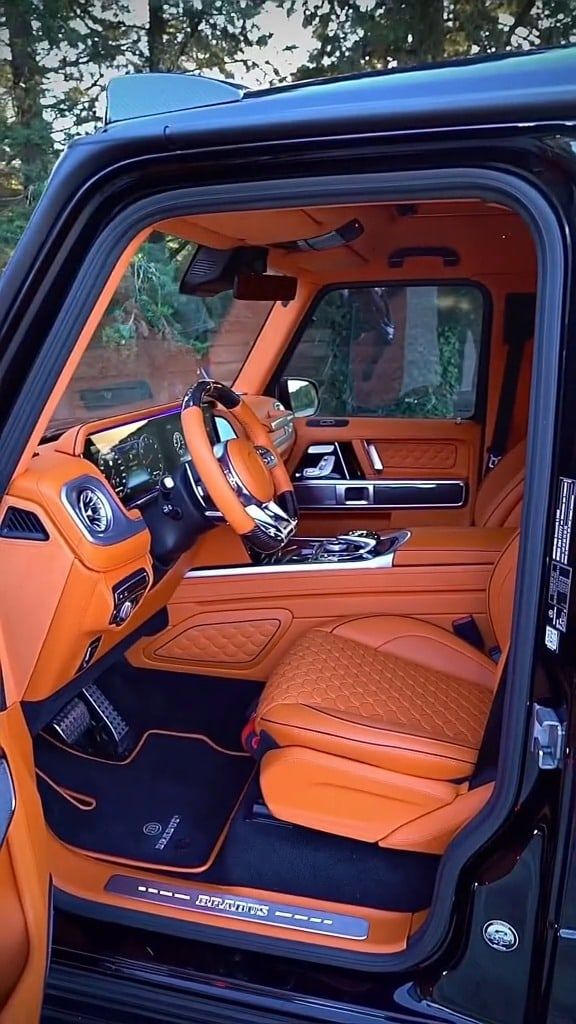
A G-Class cabin lends itself to complete retrimming: seats, rear bench, door cards, console, headlining, boot mat and steering wheel. On a W460, hard-wearing materials in a utilitarian spirit remain in keeping; on a W463, leather and contrast stitching underline its luxury calling.
An example carried out in the workshop: the cabin and steering wheel of a G-Class redone in orange leather. Mercedes upholstery is carried out entirely on site; the same workshop has trimmed a Land Rover Defender in cognac leather and teak, another off-roader turned collector’s piece.
What the workshop does for a G-Class
Based in Mougins, on the Côte d’Azur, since 2017, the independent Original Classic & Luxury Cars workshop inspects, services and restores classic G-Class models, from the W460 to the last W463s. One team follows the car; parts are original, equivalent quality or reconditioned, with their origin stated, and nothing is done without your approval.
A first opinion can be given remotely: send photos and videos of the chassis, door bottoms and cabin for a quote. Transport to the workshop is arranged on request, from the UK, France or the rest of Europe.