Why does a classic Mercedes restoration start with the bodyshell?
A classic Mercedes restoration starts underneath the car. Since the Ponton of the 1950s, almost every Mercedes passenger car has used a monocoque body: floors, sills and chassis rails carry the whole car. Flattering paint can hide a tired structure, all the more so as these cars have often been repaired several times in their lives.
The areas to inspect recur from model to model, with nuances according to the generation and the history of each car. On a W113 Pagoda, the doors, bonnet and boot lid are aluminium, and repairing them follows different rules from steel. The general approach is set out on our full restoration page.
- Floors, sills and chassis rails, on a lift with the shell stripped
- Jacking points, where moisture settles
- Front and rear wheel arches, lower wings
- Windscreen pillars and surrounds, to be checked with care
- Boot floor and spare-wheel well
Straight-sixes and Bosch mechanical fuel injection
The injected straight-sixes of the W111 coupés and cabriolets and of the W113 “Pagoda” SL are fed by Bosch mechanical fuel injection: an engine-driven pump meters the fuel, a linkage connects it to the throttle and the injectors deliver it. It is a robust and precise system, provided it is overhauled and set up by someone who understands it. An injection system that is merely out of adjustment is sometimes judged faulty; diagnosis comes before any rebuild.
On the ivory 220 SEb Cabriolet, the straight-six was removed, opened up and fully rebuilt – block, connecting rods, pistons, timing and water pump – then the Bosch mechanical injection was overhauled before the engine went back into an ivory-lacquered bay. For the story of the roadster and its three engine sizes, see our page on the Mercedes W113 Pagoda SL.
Chrome, wood and seals: the finish of a classic Mercedes
A classic Mercedes is also judged by its brightwork. Grille, bumpers, overriders, hubcaps, window frames and badges are removed, catalogued, then restored or replaced: pitted chrome refitted to a fresh body is noticed at once. Our chrome plating page describes this work.
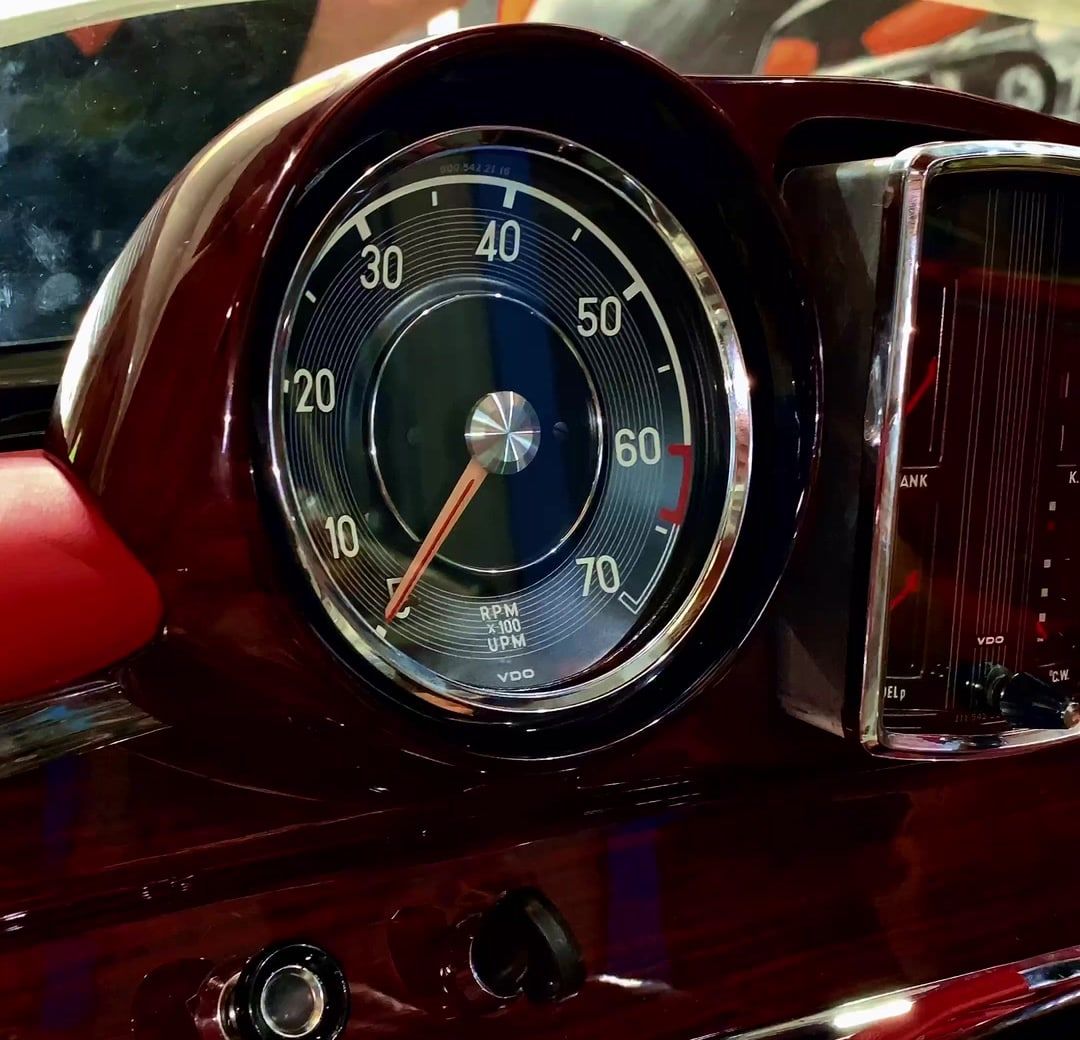
Inside, the dashboard and console wood is removed, sanded and re-lacquered where the veneer allows. Door, window and boot seals are replaced: on a Mercedes they are part of the perceived quality as much as of the weatherproofing.
Leather, MB-Tex, soft top and hardtop
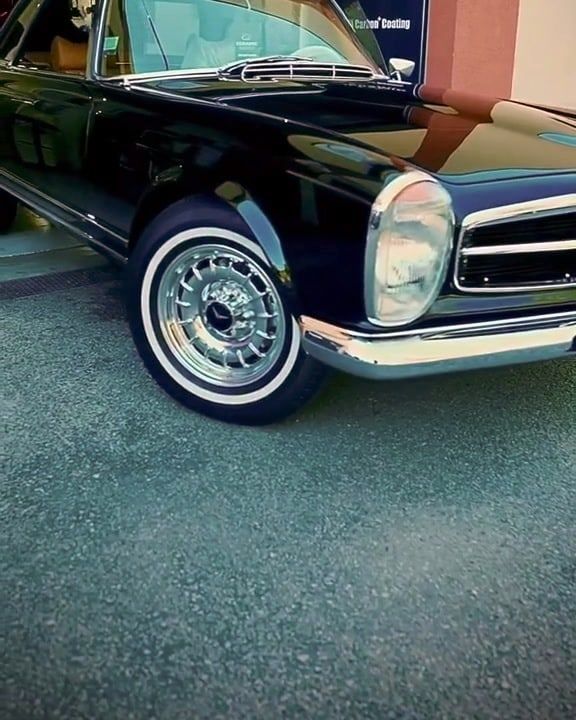
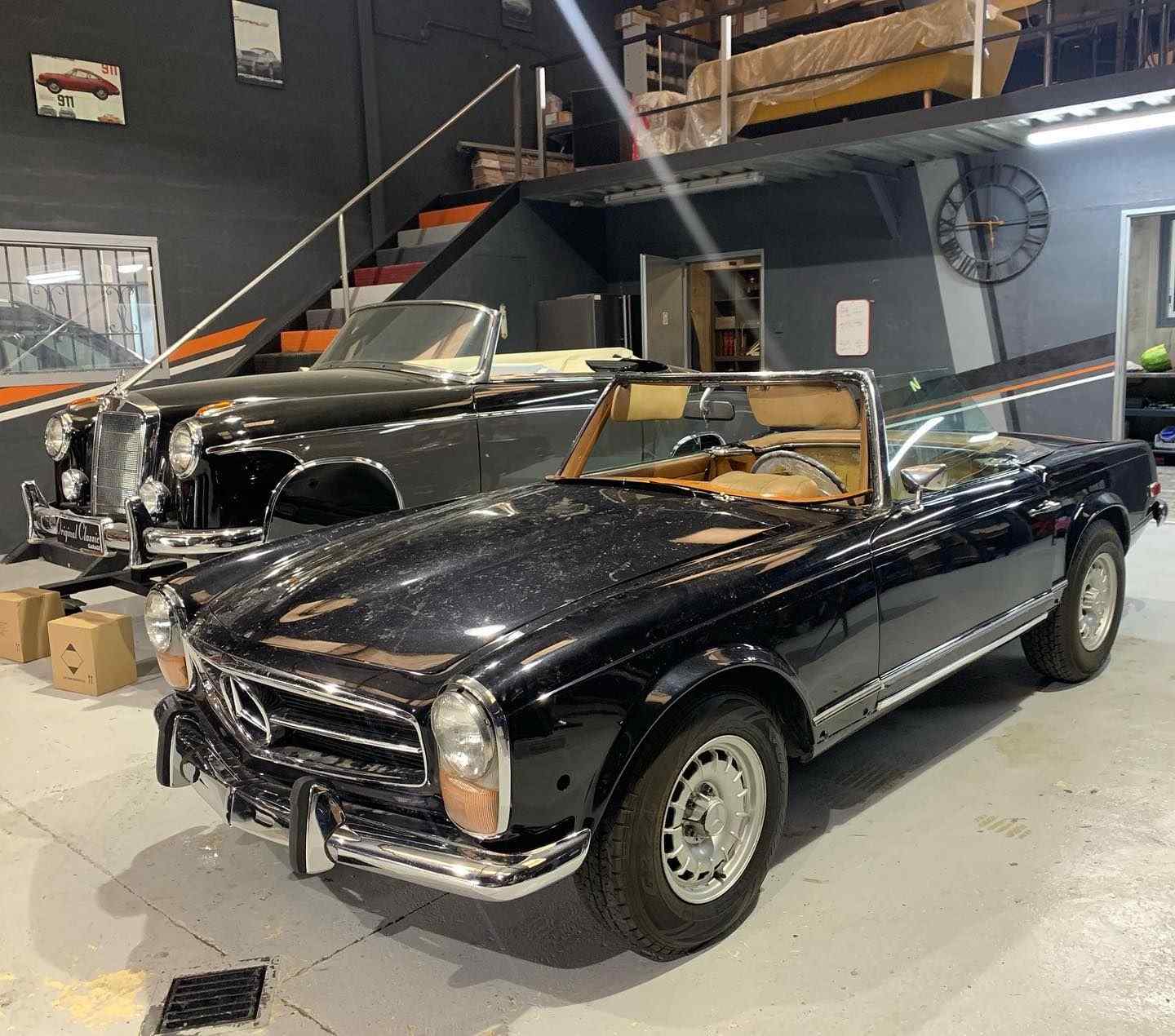
Depending on the period and the original order, a classic Mercedes is trimmed in leather, cloth or MB-Tex, the company’s own leatherette, known for its durability. Restoration begins with a choice: return to the original material and colour, or reinterpret them. On the black 280 SL Pagoda, seats, door cards, dashboard and boot were retrimmed in cognac leather with sewn pleats, under black lacquer applied in the booth to a bare-metal shell. Mercedes upholstery, carried out entirely in the workshop, has its own page.
On SLs and cabriolets the soft top matters as much as the interior: fabric, frame, mechanism and seals are checked together. The hardtop of a Pagoda or an R107 is treated as a body panel in its own right, with its paint, chrome and seals.
Automatic gearboxes, suspension and brakes
Many classic Mercedes left the factory with an automatic gearbox designed by the company itself, like the workshop’s 280 SL. These period gearboxes age well if their fluid, adjustments and controls are looked after; a gearbox that slips or shifts poorly is diagnosed first, before any decision to rebuild it.
On the W111 and W113, the front suspension is mounted on a subframe: it is dismantled, checked and overhauled – bushes, ball joints, springs, dampers. On the 220 SEb the gearbox was rebuilt, the subframe and front springs were painted black and the brake backing plates were replaced with new parts.
Mercedes R107 SL, W123 and W124 restoration
A Mercedes R107 restoration follows the same logic as a Pagoda, with its own points of attention: corrosion to watch under seals and in box sections, the soft-top mechanism, Bosch K-Jetronic injection on many versions. The W123 and W124, long seen as everyday cars, now receive the same care: bodyshell, wood trim, MB-Tex or velour, wiring.
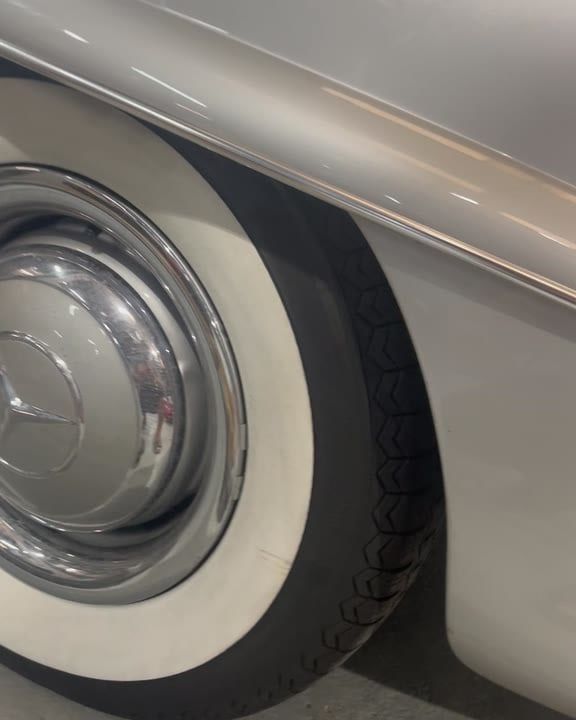
Not every car needs a full restoration. The silver Mercedes 190 SL presented in the workshop shows what careful finishing brings to a car: engine bay, red leather, ivory steering wheel, chrome and whitewall tyres. Our Mercedes 190 SL page traces the roadster’s history.
How does a Mercedes restoration work at the workshop?
The car is inspected before any estimate. The estimate itemises every stage – bodyshell, mechanics, chrome, upholstery – and original, equivalent or reconditioned parts are listed with their origin. During the work one team follows the car and you receive photographs of the key stages; no additional work is carried out without your approval.
Respecting the original or reinterpreting the car remains your decision. A first opinion is possible from photographs and videos: request a restoration estimate, and transport of the car can be arranged on request.